About
The project examines how the Rwandan Patriotic Army (RPA) ended the Genocide against the Tutsi in Kigali. The RPA’s central strategy was to end the Genocide. To achieve this end, it utilized military and humanitarian operations through conventional and guerilla tactics to both fight genocide forces and save targetted Rwandans. This project provides insights into how the Genocide in Kigali ended.

Rwanda and the Genocide:
Rwanda is perhaps best known for the 1994 Genocide against the Tutsi when up to one million Tutsis and non-extremist Hutus were killed by Hutu extremists. The Genocide’s was the culmination of decades of anti-Tutsi public policies and propaganda. It only ended when the Rwandan Patriotic Army (RPA) liberated the country. Despite the many books on the Genocide, little is known about how it ended.
Strategic Theory:
This research relies on strategic theory to understand the motivations, policies, tactics, and desired ends of both the genocide regime and the RPA. M.L.R. Smith and John Stone define strategic theory as “Strategy is concerned with the ways in which available means are employed in order to achieve desired ends.” For more information on strategic theory, please read Smith, M.L.R., “On Efficacy: A Beginner’s Guide to Strategic Theory,” Military Strategy Magazine, Volume 8, Issue 2, fall 2022, pages 10-17. (Link)
Genocide and Strategy:
For the genocide regime, led by akazu leaders such as Augustin Ndindiliyimana, Théoneste Bagosora, Felicien Kabuga, Jean Kambanda, Théodore Sindikubwabo, and many more, their strategic goal was the extermination of Rwanda’s Tutsis to retain economic, social and military control. It used genocide actors such as the Interahamwe to find and kill Tutsis while its military, the Forces Armées Rwandaises (FAR), fought the RPA and engaged in genocidal massacres.
The Rwandan Patriotic Front (RPF) and its military wing, the RPA, central strategic goal was the end of the genocidal killings. It reached this end by fighting the FAR and Interahamwe, along with humanitarian rescue missions. These missions constricted military operations, as saving Rwandans, whether Hutu, Tutsi, or Twa, was the RPA’s primary goal.
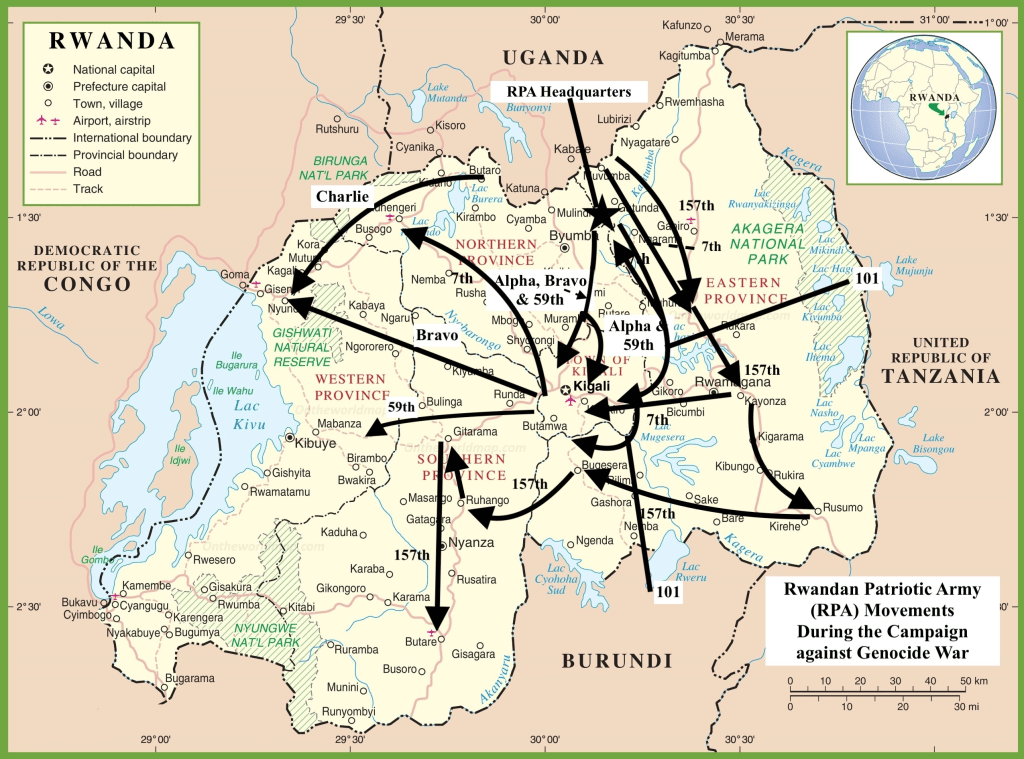
Campaign against Genocide War
On the night of April 6th, 1994, Rwandan President Juvenal Habyarimana’s Presidential Plane was shot down while approaching Kigali International Airport. The President’s death, along with other top Rwandan officials and Burundi’s President Cyprien Ntaryamira, ignited the Genocide against the Tutsi (also known outside of Rwanda as the Rwandan Genocide). Within 100 days, the nation witnessed up to a million Tutsi and non-extremist Hutu deaths by Hutu extremists. The targeted killing of Rwanda’s Tutsis only ended when the Rwandan Patriotic Army (RPA), the military wing of the Rwandan Patriotic Front (RPF), defeated the genocide forces. While Kigali’s liberation was on July 4th, it would take several weeks (Gisenyi was taken by July 18th, but Opération Turquoise prevented RPA from taking control of southwestern Rwanda until August 21st) for the rest of the country.

The goal for the project:
This research, funded by the Arts and Humanities Research Council (AHRC) and conducted at the Department of War Studies, King’s College London, hopes to educate not just genocide researchers but students and researchers in war studies, strategic studies, and Rwandan history. More importantly, this is a resource for Rwandans to understand how the RPA ended the Genocide against the Tutsi in Kigali.
 Jonathan R Beloff