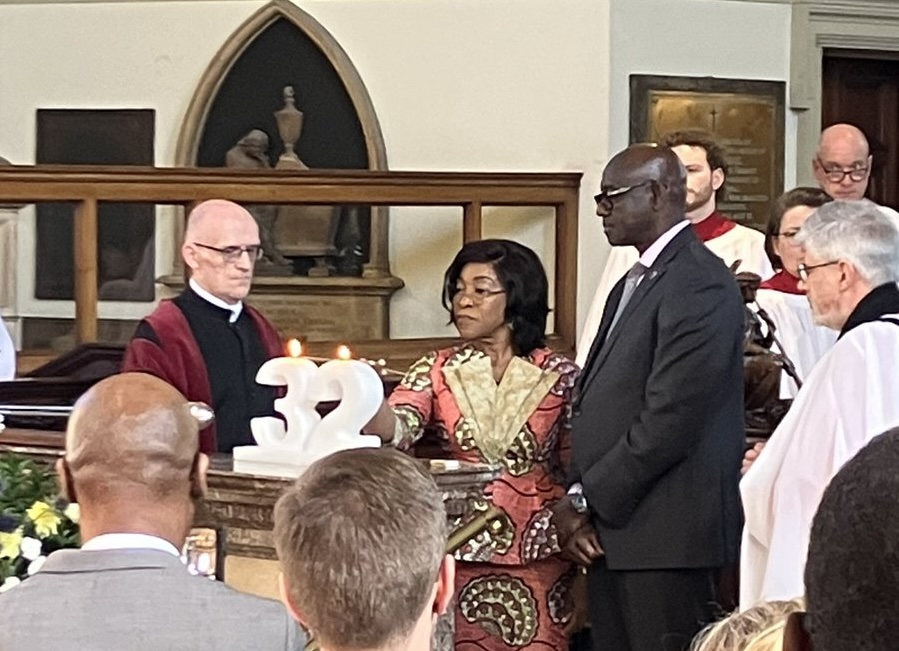
On 7th April 2026, I sat at St Marylebone Church waiting for this year’s commemoration for the Genocide against the Tutsi to begin. Every year since 2012, I have attended commemorations, whether in the United States, the United Kingdom or Rwanda. In Rwanda, while the official commemoration is on 7th April, more localised events occur throughout the 100 days, often, though not exclusively[1], ending by July 4th. Even during the COVID-19 pandemic, I attended online events. For many in the West, commemorations are often fraught with the academic divide over Rwanda’s government, or with the view that it is an event just to be studied.
Perhaps stemming from remembering my own family’s relatives who perished in the Holocaust, commemorations have always been an important event to attend. They are not just for the remembrance of those who died, but also for how we rebuild. The Rwanda High Commission’s commemoration focused less on the horrors of the Genocide, which witnessed roughly one million Tutsis and non-extremist Hutus massacred by Hutu extremist ideology, and more on how the day is a moment to stop and remember those who are gone. It is also the chance for Rwanda to assess both how far the nation has come in the last thirty-two years and how near the future is.
Honestly, the Rwanda High Commission led an excellent commemoration with High Commissioner Johnston Busingye providing a brilliant speech that balances the politics of justice, with many genocide perpetrators still residing in the UK, with the importance of continuing the path towards social reconstruction (Ndi Umunyarwanda) and economic development. However, there was something that irritated me during the day.
I looked around the church pews, packed with mostly Rwandan faces, and began counting academic colleagues. Including myself, there were only a handful whom I could spot. Next to me was one, with whom I later discussed my enquiry. Where were our colleagues?
Since the 1994 Genocide against the Tutsi’s end, Western academics continue to swarm Rwanda to understand the Genocide, reconciliation and development policies. There are likely more than a thousand books, chapters and journal articles on Rwanda. Composed mostly by Western academics, they attempt to describe what happened in Rwanda that led to the horrible massacres and what has happened since 1994. However, a majority attempt to assess through their own beliefs and perceptions, influenced by Western thought, whether Rwanda made the correct decisions.
As I wrote in my review of the academic divide on Rwanda, researchers and academics are split between praising and condemning the nation’s post-genocide development. I differentiate myself by researching, analysing and writing about how Rwandan policymakers and ordinary citizens perceive public policies. I largely try to avoid determining whether the right decisions are made. As I often say, my US passport provides me the ability to escape the consequences of my public policy suggestions, akin to how all, except a few, Westerners left Rwanda during the first week of the Genocide. Their departure shaped Rwandan perceptions of Westerners, fostering distrust that, if the situation deteriorates, they will be left behind while the muzungus flee.
But many academics have made their careers from Rwandan studies. They travel to Rwanda, often spending only a few weeks or, at best, months, and become ‘experts’ on the country. They then teach, present or write less about their observations and more about their analysis. They build careers, becoming professors, lecturers or readers on the subject. Many universities have professors who focus on Rwanda’s Genocide, Gacaca, memorialisation, reconciliation, and related topics. However, once they reach the promised land of a secure career at the university, their attitudes often change. Some become very critical of the same nation which helped build their careers.
While searching the church, I remembered a comment from a retired RDF soldier, formerly of the Rwandan Patriotic Army (RPA), who fought during the Campaign against the Genocide War. In 2023, I interviewed him along with many other former RPA and Rwandan Armed Forces (ex-FAR) members for my book on the Campaign against Genocide War. His distrust of Western researchers made the initial interaction rather difficult. As he would later say to me, he felt that Western researchers came to Rwanda, collected what they wanted (often just to verify their preexisting opinions) and then left to write their publications. They soon stop caring about those they used once, and they board their planes back to the West. They, Westerners, will be friendly and open only when they need something.
Initially, our interview was only going to be an hour, but it lasted over three hours. He even invited me to his daughter’s upcoming wedding, which I had to miss. I did ask him about the shift in his attitude towards me, as he had begun as cold and dismissive. But eventually, his demeanour became warm, and we laughed at the end about APR FC (a local football club). He answered my question with a smile, saying that I actually appeared to care and that I was more Rwandese than a muzungu.
Once again, this story popped into my mind during the commemoration as I looked around the church hall. Where were my colleagues who reside or teach in the universities dotted around London and the nearby cities of Cambridge and Oxford, to name a few? I thought of one person in particular, whom I had hoped would be a mentor of mine years ago, who again had not bothered to attend, despite having recently brought one of his classes to Rwanda. Where was he or any of his students? As in years past, he was absent.
While a handful of Rwanda-focused researchers do attend commemorations, a majority do not. Perhaps it is unreasonable to ask those who claim to be ‘experts’ on Rwanda, reconciliation or gacaca to attend the commemorations. Maybe they will say that attending these commemorations might impact their objectivity. Maybe they do not want to be seen at an event that presents a historical narrative they either disagree with or are trying to change in their quest to be human rights or social justice warriors. Or maybe having small events in the comfort of their universities is enough, even if the larger Rwandan diaspora attends other commemorations held by Rwandan embassies, diasporic-organised events, and so on.
However, after witnessing what I did at St Marylebone Church, I have concluded that those researchers and academics are wrong. They should be coming to the genocide commemorations to pay their respects. It is the bare minimum for them to spend a few hours or a day being with Rwandans during this period, as Rwanda helped build their careers. Too many show so little gratitude, as seen in their absence on one of the most difficult and important days for Rwandans. I fully expect to receive backlash and be (somewhat still) blackballed by the academic world for writing these thoughts.
However, Rwandans often comment to me on what they believe is the lack of respect. And they are right.
[1] I have attended commemoration events for genocidal massacres that occurred during Opération Turquoise.
 Jonathan R Beloff