Categories
Uncategorized

Faustin Twagiramungu: A Dinosaur of Rwandan Politics Long Gone

On 2nd December 2023, the news broke on social media that Rwanda’s former Prime Minister Faustin Twagiramungu died in Belgium. While most Global North-based activists mourn his loss and make somewhat questionable claims of him being a ‘symbol of democracy’ for Rwanda, his loss in Rwanda will go relatively unnoticed. This brings up an interesting question of what happened to Twagiramungu in the consciousness of not just the Rwandan public but the new generation of Rwandans whose lives consist mainly after the Genocide against the Tutsi. Global North social activists will answer how minor mention of his death in Rwanda originates from President Paul Kagame or the Rwanda Patriotic Front (RPF). However, that is problematic as it does not reflect the realities in Rwanda.

Who Was Faustin Twagiramungu?

Born in 1945 in Cyangugu Province, Twagiramungu lived a relatively everyday life for a Rwandan Hutu. Since independence in 1962, Rwanda’s social norms favoured the majority Hutu (composing roughly 84% of the population) over the minority Tutsi (comprising approximately 15%) and the minority Twa (comprising less than 1%). The previous 1959 Hutu Revolution, promoted by the nation’s first post-colonial President, Grégoire Kayibanda, glorified Hutu supremacy. Mass pogroms led to thousands of Tutsi to flee into neighbouring countries. Over the coming years, anti-Tutsi pogroms left thousands dead and tens of thousands to flee into neighbouring countries. During the First Republic (1962-1973), southern Hutus, such as Twagiramungu, received economic, political and societal favouritism. However, he did not receive the benefits of his ethnic and geographical origins for long as he studied and worked in Canada starting in 1968 and continued until 1976. It was during the reign of General Juvénal Habyarimana, who overthrew Kayibanda in a coup d’état that he returned to run a transportation company called Société des Transports Internationaux au Rwanda (STIR).

His business success outstripped his now disenfranchised origins. President Habyarimana and his inner circle called the akazu, loosely translated as ‘little house’, shifted favouritism from the South to the North. Tutsis still experienced institutional racism, nonetheless. The geographical power shift and anger towards the President led him into politics. However, Rwanda’s political landscape was changing. The one-party dictatorship of Habyarimana began to loosen. As Kroslak writes, Rwanda and many African nations under the French’s sphere of influence started a ‘Paristroika’ moment. With the Cold War ending and Western capitalism winning the ideological war, the Western donor nations of the United States, France and Great Britain demanded political and economic liberalisation. This new movement became an opportunity for Twagiramungu.

The Beginning of his Political Career and the Genocide against the Tutsi:

In 1991, he became a prominent Mouvement Démocratique Républicain (MDR) member. While MDR attempted to differentiate itself from Habyarimana’s party, the Mouvement Révolutionaire National pour le Développement (MRND), by claiming it was the ideological successor of former President Kayibanda and his lost political party, the Parti du Mouvement de l’Emancipation Hutu (Parmehutu) were banned and dissolved shortly after Habyarimana’s coup. Additionally, MDR softened its tone on Tutsis compared to its predecessor. But like many of Rwanda’s new political parties, there were significant divisions based not only on Rwanda’s Tutsi population but also on whether to engage with the RPF.

In October 1990, the RPF’s military wing, the Rwandan Patriotic Army (RPA), crossed from Uganda to attack the Rwandan military, the Rwandan Armed Forces (FAR). The beginning of the Liberation War (1990-1993) began with initial setbacks for the RPA. Successful tactics and offensives in 1991, 1992 and 1993 led to peace negations and political transformations. By August 1993, the RPF and the Habyarimana regime agreed upon the Arusha Accords. The akazu lost significant power as Rwanda’s political system broadened beyond the original ‘Paristroika’ of the early 1990s to include the RPF. This benefited Twagiramungu’s career and ambition.

Including the RPF in Rwanda’s political space led to President Habyarimana being much more tactical in engaging with the opposition parties. He used wealth, favours and threats to divide political parties. The MDR was no different, especially after the forced exile of MDR leader and Prime Minister Dismas Nsengiyaremye in July 1993. His favouritism towards working with the RPA led him to be seen as an ‘accomplice’ by the FAR and Habyarimana. While Twagiramungu would be the ideal replacement, he instead manoeuvred for Agathe Uwilingiyimana, a moderate within the party, for the Prime Minister position. She would later die during the Genocide against the Tutsi. It is important to note that while MDR had its moderates, it also had its Hutu extremists, such as Jean Kambanda, who would become Rwanda’s Prime Minister during the Genocide against the Tutsi.

On the night of 6th April 1994, the Falcon-50 Presidential Plane carrying President Habyarimana was shot down, most likely by FAR extremist actors, igniting the Genocide against the Tutsi. Twagiramungu resided in Kigali and received help from the United Nations Assistance Mission in Rwanda (UNAMIR), who brought him and his family to safety at their base in Kissimenti. Prunier, Dallaire and Anyidoho write of how UNAMIR forces, rather than the better equipped RPA, who had previously stationed its 3rd Battalion (more popularly known as the 600), rescue Twagiramungu’s life. There is speculation that he did not want to be saved by the RPA in order to retain the image of independence from the RPF, unlike Nsengiyaremye. Whatever the reason, he did not want RPA assistance; nevertheless, he benefited from their protection at Amahoro Stadium. Shortly after the Genocide began, the RPA’s 3rd Battalion, under the command of Lt. General Charles Kayonga, sent Eagle Company to Amahoro Stadium, which housed UNAMIR’s headquarters, to protect it from military and genocidal forces. The Genocide ended when the RPA defeated and removed the genocide regime on the 18th of July 1994. The Campaign against Genocide War had ended, but Rwanda’s landscape dramatically changed.

After the Genocide:

Despite winning the war, the RPF kept much of the previous 1993 Arusha Accords in place. There were changes, such as the Hutu extremist parties that were once in the government would be banned. Their political seats and ministries were distributed to other parties but mostly RPF. While there were only minor changes in the new post-genocide transitional government compared to the one agreed upon in the Accords, Rwanda had changed. During the first few days of the Genocide against the Tutsi, non-extremist, politically active Hutus were targeted alongside Tutsis by genocide forces. The political party’s divisions, which President Habyarimana created within many oppositional parties, provided opportunities for extremist elements to kill off moderate party members during that first week. Many of the extremist political party members were either dead or fled the country. Thus, few oppositional leaders left when the war and Genocide was over. Twagiramungu was one of the lucky few.

In accordance with the Arusha Accords, the MDR retained the Office of the Prime Minister. Twagiramungu, being one of the few remaining MDR members, became the nation’s new Prime Minister. While he had hoped the position would grant him political favour, he did not realise how the political landscape had changed. Unlike the early 1990s, Rwanda was now under the control of the RPF, which had just ended the Genocide against the Tutsi and won the Campaign against Genocide War. They suffered the least in terms of lost political leaders. However, they were not immune to the political changes that had taken place. Kimonyo writes how, during the remaining 1990s, some RPF officials wanted to rule the country as the past presidents had done. This is not in reference to a political dictatorship but the style of politics and corruption that had existed before. The infighting, corruption and ineptness led to not only the removal of Rwanda’s post-Genocide President Pasteur Bizimungu in 2000 but a significant shakeup in the party and country. Vice-President and Minister of Defence Paul Kagame became the next President and de facto leader of the RPF.

Even before the constitutional changes in 2000, which included some of the first legislation to ban ethnic divisionism, the political system was considerably different than what Twagiramungu had hoped. The 1995 Kibeho Massacre, along with a diminished role in policymaking, led Twagiramungu to speak out against the post-Genocide government. He increasingly claimed that Hutus within the government were either puppets or their ethnic concerns were ignored. Recall that Twagiramungu grew up in Rwanda’s ethnic divisions, which had always not only favoured Hutus but acknowledged ethnic partitions. This radically differed from the RPF’s desired social belief, which dismissed ethnic divisionism to foster the unifying social norm of Ndi Umunyarwanda, loosely translated as ‘I am a Rwandan.’ While the policy would come into existence years later, the institutional foundation for social unity began shortly after the installation of the post-Genocide government.

Twagiramungu resigned as Prime Minister on 28th August 1995. He claimed it was a result of the Kibeho Massacre. However, this is not the whole answer, as he would never have longed for this new political landscape. Unlike those such as the current Minister of Foreign Affairs Vincent Biruta, a member of the Parti Social Démocrate (PSD) and saved by the RPA’s 3rd Battalion during the Genocide, he still felt that the pre-Genocide political atmosphere of Rwanda still existed. Fundamentally, it was gone, and he became somewhat of a dinosaur of a past political environment that no longer existed. The RPF were the winners of the Liberation and Campaign against Genocide War and thus set the tone for Rwanda’s political system. Even that system did not last long as by 2000, Paul Kagame began his Presidency, which continues until today. Rwanda’s political landscape would never return to the early 1990s.

Life outside Rwanda:

Twagiramungu departed Rwanda for Belgium in March 1996. It was there he created the oppositional party, Democratic Forces for Resistance, in 1997. Working with other exiled movements and former political leaders of the Habyarimana regime, he tried to mount a serious campaign against the RPF. However, there would be little hope for proper coordination as the widely different political parties, each holding various beliefs, never unified.

Despite Twagiramungu’s lack of recognition of the shifting political landscape and greatly diminished role for him and his party, he nevertheless attempted to run for President as an Independent during the 2003 Presidential Elections. His platform focused on economic issues and questioned the RPF’s social messages. He ran as an Independent as the MDR party became banned months before the election. The Rwandan government responded that its ban resulted from continued belief in ethnic divisionism. However, some members formed a new party, the Party for Progress and Concord (PPC), which currently has one representative in the Chamber of Deputies. As expected, Twagiramungu lost the election to President Kagame, winning just under 140,000 votes compared to his opponent, who won over 3.5 million. While international observers claimed election interference, there was little chance for Twagiramungu to win the election.

By 2003, Rwanda’s political landscape had changed again. President Kagame was now in control, and the nation would see changes towards economic growth, increased access to education and healthcare, and what Rwandans tell me is their most pressing concern: security. The political dynamics found in Rwanda in the early 1990s were now impossible to recreate. Additionally, Rwandans became somewhat sceptical of Western constructs of political liberalisation, which was perceived as a reason for Hutu extremist parties and actors gaining the power to conduct the Genocide against the Tutsi. Political landscapes had changed not just in Rwanda but throughout central and eastern Africa.

Despite the seeming rejection of Twagiramungu in 2003, it did not end his political ambitions. He formed the Rwandan Dream Initiative (RDI) in 2010. He later combined the party with others, including the Democratic Republic Liberation for Rwanda (FDLR), which contains remnant genocide forces, to form the Coalition of Political Parties for Change (CPC). The CPC’s inclusion of the FDLR is highly problematic as the Hutu extremist rebel force in eastern Congo holds policies containing Rwanda’s return to ethnic divisionism and ‘finishing’ the Genocide. The party collapsed within a year, but he remained President of the RDI party. However, he continued to be accused of being aligned with the FDLR’s genocide ideology. Until his final days, Twagiramungu continued to be active on social media, criticising the Rwandan government President Kagame and denying important facts about the Genocide against the Tutsi. He became an advocate of the false ‘Double Genocide’ theory, which claims the RPA committed their Genocide.

Twagiramungu’s Significance Today?

Twagiramungu’s recent passing holds little significance in Rwanda. Most Rwandans I talked to while conducting fieldwork either knew little about him (just that he was a Prime Minister and critic of the government) or were not interested. He is seen as a relic of the past or a historical footnote who did not adapt to Rwanda’s shifted political landscape. He also offered little to Rwandans who were satisfied with the status quo under the RPF. The stability the RPF brought to Rwanda should not be so easily dismissed. Rwandan informants often comment on how Global North critics live a privileged life of security, which leads to the great benefit of not knowing what it seriously means to have their lives at risk. The political luxuries in the Global North take time to develop, with most Rwandans expressing their satisfaction with the political stability even if it is not perfect.

Twagiramungu and his oppositional political successors, such as Victoire Ingabire Umuhoza, try to operate within a Rwandan landscape that does not exist anymore. Most Rwandans, especially the growing Millennial and Generation Z population, are not interested in the political pluralism in the Global North or Rwanda during the early 1990s. While critics of the Rwandan government will quickly dismiss this notion, their voices do not represent the ones residing in Rwanda. Rwandans frequently express their views of Rwandan politics to me, often with many complaints from local officials or scandals. However, very few want President Kagame to be replaced. Instead, many express their concerns if President Kagame steps down in the near future.

Twagiramungu, Victoire Ingabire and others see Rwanda through the lens of the early 1990s rather than Rwanda in 2023. This is why their political impact on Rwanda will remain negligible at best.
Categories
Uncategorized

DRC elections: the Kabila family legacy looms large over the country’s polls

Jonathan Beloff, King’s College London

The Democratic Republic of Congo is expected to hold elections on 20 December 2023. The country’s electoral commission has announced President Felix Tshisekedi will be seeking reelection alongside 23 other candidates. They include Nobel Peace Prize winner Denis Mukwege and the runner-up in the 2018 presidential election, Martin Fayulu. The courts will confirm the final list of candidates. One key political figure has yet to make his intentions known: Joseph Kabila. He was president for 18 years until Tshisekedi took over in 2019. The DRC’s constitution allows two five-year terms, but he remained in power by delaying elections. He holds substantial political, military and business sway. Jonathan R. Beloff is a political scholar who researches the politics and security of the Democratic Republic of Congo, Rwanda, Burundi and Uganda. We asked him some questions.

What is the Kabila family’s place in the DRC’s politics?

Joseph Kabila was the country’s fourth president. He took office after the assassination of his father, Laurent Kabila, who was killed by his bodyguard in 2001. Joseph later won presidential elections in 2006 and 2011.

The surprise 2018 election of Felix Tshisekedi, who took power in January 2019, as president interrupted more than two decades of the Kabila family’s rule. At the time, Joseph was constitutionally barred from running for president – and he had already overshot his second term by more than three years.

The Kabila family became a political powerhouse after gaining control in 1996. With the assistance of other countries – such as neighbours Uganda, Angola and Rwanda – the Alliance of Democratic Forces for the Liberation of Congo, under the leadership of Laurent Kabila, overthrew the long-standing Zairian dictator, Mobutu Sese Seko. This was during the First Congo War (1996-1997).

Laurent’s tenure was riddled with ineffectiveness and corruption. In less than two years, he had dismissed his minister of defence, the Rwandan James Kabarebe, and begun arming anti-Rwandan forces. These forces contained actors who participated in the 1994 genocide against the Tutsi in Rwanda.

Laurent claimed his government only backed these forces after Rwanda attempted to overthrow his regime.

The bloody Second Congo War (1998-2003) led to at least two million deaths, many of them from disease and extreme poverty rather than warfare itself. While Kabarebe’s invasion attempt on the capital Kinshasa in 1998 failed, the vast DRC was divided into spheres of influence for different nations and their aligned rebel groups. This status quo only began to break after Laurent’s assassination, which led to the rise of his son Joseph.

Joseph learned military strategy, tactics and politics under Kabarebe. The two worked together after the Second Congo War to flush out many anti-Rwandan forces. This included the Democratic Forces for the Liberation of Rwanda. They also campaigned together during the 2011 presidential elections, which Joseph won.

Joseph initially cast himself as a reformer who would end the Second Congo War and pursue policies to spur political and economic development. However, instability in eastern Congo persisted under his rule, with accusations of massive corruption that undermined the nation’s development.

How much sway does Joseph Kabila hold today?

Joseph Kabila remains a strong presence within Congo’s political, economic and military institutions. He has strong networks developed over 18 years in power. He could use this influence to sway the vote towards any of the candidates.

His influence stems from favourable business and political alliances he created when he was president. Like Mobutu, Kabila used his vast financial resources to secure favourable relationships with Congolese and foreign business leaders. A document leak in 2021 revealed that Kabila received over US$138 million from corruption and bribes.

There were claims that the former president originally convinced Tshisekedi to accept a power-sharing agreement. Under it, Tshisekedi would be president, while Kabila would control political decisions behind the scenes. The near appointment of Ronsard Malonda as the president of the electoral body illustrated Kabila’s political influence. Malonda held senior positions during the country’s 2006, 2011 and 2018 elections. He has been accused of rigging results in favour of Kabila.

Such accusations have benefited Tshisekedi’s election campaign. He is depicting himself as a candidate not tied to the corruption within DRC.

If Kabila does decide to campaign, political dynamics within much of Congo’s civil society, military and economy will be divided. Government ministers and officials will be forced to choose to support either the incumbent or Kabila’s preferred candidate.

What was Tshisekedi expected to change after he routed Joseph Kabila?

There was initial hope that Tshisekedi’s government would foster peace in eastern Congo, establish greater national unity and help solve the nation’s economic woes after decades of corruption and conflict. However, these problems have persisted.

Initially, Amnesty International praised Tshisekedi for pardoning political prisoners and allowing greater public space for criticisms of the Congolese government. He also began investigations on past mineral deals during the Kabila governments. As the African Union chair from 2021 to 2022, he pushed for greater attention to the COVID-19 pandemic and promoted the African Continental Free Trade Area.

Despite initial attempts to foster more significant relations with Rwanda, relations soured in 2022. This was after the Congolese government accused Rwanda of supporting the resurrected M23 rebels.

Rwanda denied the allegations. It has also accused Tshisekedi’s government of being hostile to the Congolese Tutsi population – the Banyamulenge – who are historically related to Rwandans.

The US Department of State has expressed concern about Tshisekedi’s anti-Banyamulenge rhetoric, as well as democratic transparency in the upcoming election.

Tshisekedi’s campaign strategy seems to focus on promoting security in eastern DRC by not only defeating the M23, but also attacking Rwanda for interfering in Congolese affairs. The securitisation of the Banyamulenge and Rwanda – the political manipulation to stir public fear – has helped deflect internal criticisms of the Tshisekedi regime.

Whether the elections take place is another area of concern. There are concerns that Tshisekedi will delay or cancel the election by citing security concerns. If this happens, it might be perceived by domestic and international partners as political interference by the ruling regime.

Jonathan Beloff, Postdoctoral Research Associate, King’s College London

This article is republished from The Conversation under a Creative Commons license. Read the original article.

Categories
Uncategorized

Commercial Diplomacy in Action: Rwanda’s Partnership with FC Bayern Munich

On 27th August 2023, the Rwandan Development Board and FC Bayern Munich announced a five-year sponsorship deal. For Rwanda, this is not the first time they partnered with an internationally known football club to promote Rwandan tourism.

In 2018, Rwanda signed a three-year, £10 million per year sleeve sponsorship deal with Arsenal football club. The following year, in 2019, it signed a new three-year agreement with Paris Saint-Germain (PSG) for somewhere between €8 to €10 million per year. Akin to the Arsenal deal, the sleeve deal would advertise Rwandan tourism under the slogan ‘Visit Rwanda’.

Akin to the previous deals, the new Bayern Munich sponsorship raises criticisms about whether a developing country such as Rwanda should use its national finances on these deals with billionaire football clubs. Additionally, questions arise about whether these football clubs should be engaging with a country that faces accusations by human rights groups for interference in neighbouring Democratic Republic of Congo and domestic human rights abuses. While this accusation is nothing new, it ignores why the Rwandan government believes it needs to partner with these international football clubs.

What is the Strategy for Rwandan Development?

Within the Rwandan government is a drive towards economic development to prevent future genocide. The Genocide against the Tutsi in 1994 witnessed an estimated one million deaths within only 100 days. One of the believed causes for the genocide was the lack of economic development, thus leading to people having the time to commit massacres. While the likelihood of another genocide is relatively minimal, it still is feared by the current government. Additionally, the current government wants to limit the economic impact of foreign aid withdrawals, as seen in 2012-2013.

While Rwanda is still reliant on foreign aid, composing up to 40% of national income, there is a strong distrust in it as a reliable mechanism to promote sustainable development. Instead, the country’s macroeconomic visions look towards developing the tourist sector. The primary tourist attraction can be found within the Virunga Mountains, which are known for their silverback gorillas. However, Rwanda is also promoting other environmental tourist areas, such as the Akagera National Park and Nyungwe National Park, along with the vacation cities of Gisenyi and Karongi.

The goal of developing these parks and vacation locations is to increase the number of not only domestic but, more importantly, foreign tourists. The expectation is that these foreign tourists will benefit the local and national economies by spending foreign currencies on hotels, park permits and other services while staying in Rwanda. This will have a knock-on economic effect that will benefit Rwandan businesses and the economy.

The Role of Commercial Diplomacy:

To promote tourism and foreign direct investment, Rwanda has pursued a policy of commercial diplomacy. Unlike more traditional forms of diplomacy, commercial diplomacy is aimed towards businesses and economic interests. The hope is that the Rwandan Development Board (RDB) can negotiate deals with foreign investors to invest in Rwanda. President Paul Kagame is a significant actor in the nation’s commercial diplomacy, often swaying business leaders such as Warren Buffett to invest in the country.

The ‘Visit Rwanda’ slogan on the football jerseys of Arsenal, PSG, and now FC Bayern Munich is a key mechanism in that commercial diplomacy. The Rwandan government perceives these sleeve sponsorships as a type of advertisement for the tourist sector. Akin to a billboard, the hope is for people in the Global North who watch these football clubs to see the slogan and, whether consciously or subconsciously, think of Rwanda.

As with any advertisement strategy, whether this is an effective tactic is up for debate. During the initial Arsenal deal, some questioned whether football fans in attendance would have the financial resources to visit the central African nation. However, the RDB believes these football clubs have a global audience that will be impacted by the ‘Visit Rwanda’ slogan on not only the jersey’s sleeves but also the practice uniforms and signs boarding the football pitch.

However, it is important to note that this is not the only tactic within Rwanda’s strategy to increase tourism numbers. The attraction of international business leaders like the previously mentioned Warren Buffett business leaders from companies such as Visa, JP Morgan Chase, Starbucks, Costco, Marriott International Inc and multiple others is included. Additionally, Rwanda attracts cultural and societal stars, such as the most recent Indris Elba and Kevin Hart visit to Rwanda.

How to Measure its effectiveness?

Akin to most advertisements, measuring effectiveness is difficult. One Rwandan café owner commented how he believed the ‘Visit Rwanda’ campaign is effective based on his experiences meeting with a more significant number of foreign tourists who said they decided to visit Rwanda after seeing the campaign. While some connections can be made between consumers impacted by advertisements, it is nevertheless unknown. The Rwandan government commits to the policy as it sees growth in the tourism sector. However, the global Covid-19 pandemic and economic slowdowns impacted tourism in Rwanda and the rest of the world.

Thus, it becomes even more difficult to conclude that these deals have benefited Rwanda. Nevertheless, tourism has increased within Rwanda. The World Bank estimates that before the sponsorship deal in 2017, Rwanda received just over 1.5 million tourists. This number increased to 1.7 million the following year before dropping slightly to 1.63 million in 2019. More recent data is difficult to verify with the pro-government newspaper, The New Times, stating how the number of tourists has recovered to 90 per cent of the pre-Covid levels

Whether the ‘Visit Rwanda’ campaign on these football kits is effective, the nation will continue to face criticism. The use of the nation’s limited resources on the campaign appears on the surface as a small developing African nation giving millions to clubs worth billions. However, for Rwanda’s economic development, the campaign is part of the nation’s overall commercial diplomacy to promote the tourist industry. Achieving this new sponsorship with FC Bayern Munich will be an accomplishment in entering the German market.

Categories
Uncategorized

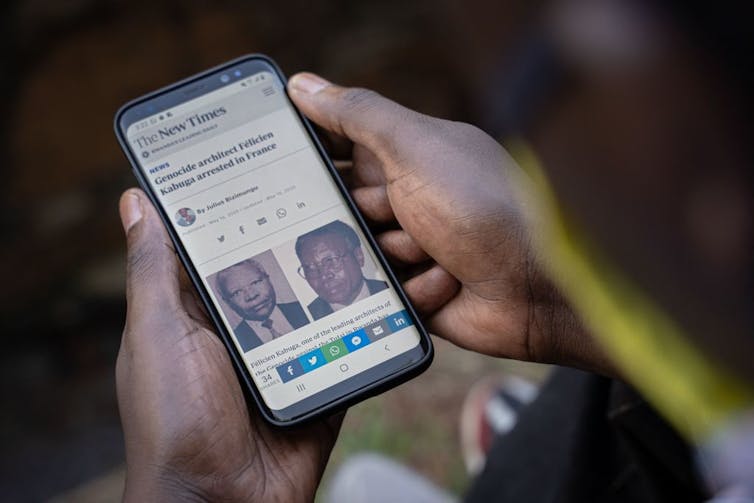
Rwanda genocide accused Félicien Kabuga is ruled unfit to stand trial: this will further erode trust in international justice

Simon Wohlfahrt/AFP via Getty Images

Jonathan Beloff, King’s College London

The International Residual Mechanism for Criminal Tribunals recently concluded a two-year court hearing on Félicien Kabuga. Kabuga is accused of crimes against humanity during the Genocide against the Tutsi in Rwanda in 1994. The court ruled that he was not mentally fit for trial.

The court proposed that the tribunal judges find an “alternative procedure that resembles a trial as closely as possible, but without the possibility of a conviction”. What this “alternative procedure” will look like is still not fully known. Rwanda’s ambassador to the Netherlands, Olivier Nduhungirehe, has suggested a court case would still occur, but without Kabuga. Questions will be raised about how this falls within international legal procedures. Jonathan Beloff, who has researched post-genocide Rwanda, explores the implications of the tribunal’s decision for genocide victims.

Who is Félicien Kabuga?

Kabuga, who claims to be 90, was a successful businessman before and during the 1994 Genocide against the Tutsi.

He gained considerable wealth from tea production during the presidency of Juvénal Habyarimana between 1973 and 1994.

In 1997, Kabuga was accused by the International Criminal Tribunal for Rwanda of seven criminal charges. These included providing funds to import weapons used to kill an estimated 800,000 Tutsis and moderate Hutus over 100 days in 1994.

He was also accused of funding a radio station that broadcasted anti-Tutsi messages.

Kabuga fled Rwanda during the Rwandan Patriotic Front’s operation to end the genocide.

He was named among 93 suspected leaders of the genocide by the International Criminal Tribunal for Rwanda. However, he remained in hiding in Kenya, Switzerland and later France.

In May 2020, French authorities arrested him at his Paris home. Kabuga has, however, denied the charges against him.

What happened after his arrest in France?

The International Residual Mechanism for Criminal Tribunals at The Hague gained custody of Kabuga shortly after his arrest. His alleged crimes fell under its jurisdiction. The Hague-based court took over from the International Criminal Tribunal for Rwanda, whose mandate ended in 2012.

Prosecution in Rwanda was never a realistic option – Kabuga was wanted by an international court, which holds legal precedence over Rwanda’s judicial demands.

Additionally, international human rights groups, such as Human Rights Watch and Amnesty International, have questioned the credibility of Rwanda’s judicial system, often claiming unfair practices and political interference. This has affected the Rwandan government in extradition applications for other genocide perpetrators. Nevertheless, Rwanda’s National Public Prosecution Authority committed to assisting the international tribunal in Kabuga’s prosecution.

The central focus of Kabuga’s case at the tribunal was his ability to participate in the hearings meaningfully. By the time of his arrest, he had suffered physical deterioration from old age and dementia. Dementia covers a range of conditions that include a loss of memory, problem-solving and language skills.

Kabuga’s lawyers argued that he was unfit for trial because of these medical conditions. Since his arrest, he has been held by The Hague-based court.

Rwandan genocide survivor organisations, such as Ibuka, have previously protested against any hindrance to what they perceive as necessary justice. But Kabuga’s lawyers’ arguments on their client’s mental well-being convinced the judges.

What are the implications of this judgement for Rwandans?

The recent court decision on Kabuga’s inability to fruitfully participate in any trial reinforces what some Rwandans expected as a failure of the international system and justice.

Shortly after his arrest, some Rwandans expressed scepticism about Kabuga’s trial that would be in Europe rather than Kigali. They say those suspected of participating in Rwanda’s genocide must be prosecuted in the country where the crime occurred. As the Ibuka executive secretary once put it:

Rwanda has all it requires to deliver standard justice.

Some Rwandans have also questioned the effectiveness of the International Criminal Tribunal for Rwanda, claiming it sought to make up for the international community’s inaction during the genocide rather than provide justice for the victims.

This tribunal cost nearly US$1 billion, and convicted 61 out of 93 Rwandan perpetrators from 1995 to 2012. In contrast, Rwanda’s domestic judicial and reconciliation system, gacaca, prosecuted an estimated one million people for various crimes and offences during the genocide at a much lower cost between 2002 and 2012. Gacaca courts were presided over by local leaders. They gave the accused opportunities to admit guilt and reconcile with victims.

This latest international court ruling on Kabuga will reinforce the belief that the international community has abandoned Rwandans who seek meaningful justice. The decision, particularly in light of the fact that genocide suspects are still at large in other countries, is likely to erode Rwandan trust in international courts’ capabilities to properly prosecute suspects and deliver justice.

Jonathan Beloff, Postdoctoral Research Associate, King’s College London

This article is republished from The Conversation under a Creative Commons license. Read the original article.

Categories
Uncategorized

Rwanda: Paul Rusesabagina’s release and apology – a master stroke engineered by Kagame

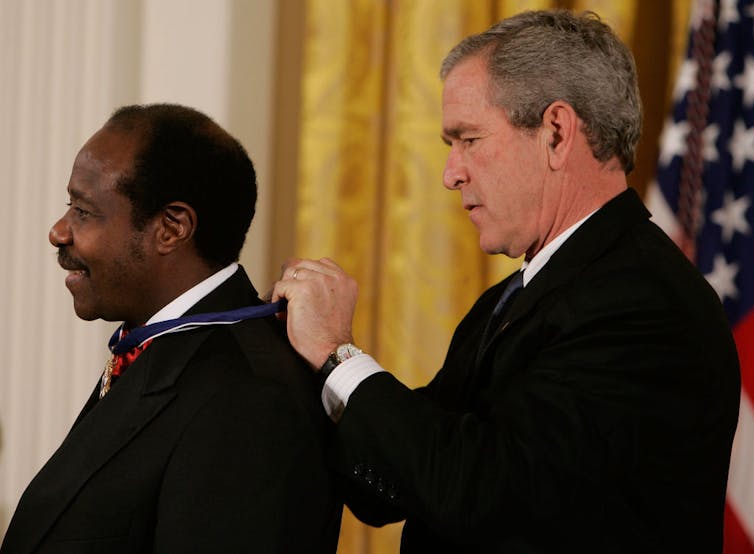
Paul Rusesabagina receives the Medal of Freedom from US President George W Bush in 2005. Mark Wilson/Getty Images

Jonathan Beloff, King’s College London

Rwanda’s ministry of justice recently announced the pardon and release of Paul Rusesabagina from jail. Rusesabagina was involved in events portrayed in the 2004 Hollywood film Hotel Rwanda.

In September 2021, Rusesabagina was sentenced to 25 years in jail over his ties to groups opposed to Rwandan president Paul Kagame. His release followed intense diplomatic talks between Washington and Kigali, and was negotiated by Qatar.

While Rusesabagina’s release may be celebrated by his supporters in the west, it’s a bit more complicated within and for Rwanda. His pardon needs to be understood within the greater context of Rwandan foreign policy, whose primary objectives are state security, reduction of foreign aid reliance and economic diplomacy.

Rusesabagina’s arrest illustrated the Rwandan government’s determination to neutralise threats it sees to its national security. His subsequent release provides important narrating elements for both domestic and foreign audiences.

In his official request for pardon from Kagame, Rusesabagina admitted to working with anti-Rwanda groups and took responsibility for their actions. This legitimises Kigali’s move to arrest him. It also provides the government with ammunition to combat future criticisms of human rights abuses over the arrest.

But perhaps more importantly, Rusesabagina’s release portrays Kagame as a pragmatist on the international stage – one willing to negotiate once a security threat is neutralised.

The pardon also helps restore the close ties Rwanda and the US have historically enjoyed. Senior US political leaders, including secretary of state Antony Blinken, had censured Rwanda over the arrest.

Domestically, the government has said Rusesabagina’s release fits within its truth and reconciliation process following the 1994 genocide against the Tutsi.

Who is Rusesabagina?

In Hotel Rwanda, Rusesabagina (played by Don Cheadle) is depicted as being the primary person to save the lives of 1,268 people hiding inside Hotel Des Mille Collines during the 1994 genocide against the Tutsi. Over the course of 100 days, more than 800,000 Tutsis and moderate Hutus were killed.

However, the Hollywood narrative has been challenged by genocide survivors who say it misrepresented facts. Instead, they say, Rusesabagina ran the hotel as a personal profit-making venture.

Rusesabagina left Rwanda in 1996, and eventually became a US resident and Belgian citizen. Following the film’s release, he received several humanitarian awards, including the US Presidential Medal of Freedom in 2005. He used his newfound platform to promote his political ambitions and ideology.

The Rwandan government accused Rusesabagina of terrorism over his funding of the Rwandan Movement for Democratic Change, which has the National Liberation Front and PDR-Ihumure military wings. These groups have called for a change of government within Rwanda and a return to ethnic divisions.

Kigali viewed this as harmful to the country’s post-genocide social development under the Ndi Umunyarwanda (I am Rwandan) ideology.

Rusesabagina aired a call for armed resistance against Kagame, and soon after, National Liberation Front militants attacked Rwanda. In June and December 2018, the group carried out two attacks in southwestern Rwanda. Nine civilians died.

These attacks sparked a harsh response from the Rwandan government, which issued an arrest warrant against Rusesabagina. He was captured on 27 August 2020, and subsequently tried and convicted. His 25-year jail term was effectively a life sentence – he is 68.

Rusesabagina’s arrest put Kagame on a collision course with Washington. The Rwandan government had arrested an American resident, and the move was seen as an attempt to silence a critic. US secretary of state Blinken and senator Robert Menendez, who chairs the senate’s foreign relations committee, were among high-profile political leaders who demanded Rusesabagina’s release.

Rusesabagina’s family petitioned the Belgian and American governments to intervene. Hollywood actors started a “Free Rusesabagina” clothing campaign. Human Rights Watch, Amnesty International and other rights groups added their voices.

Why pardon Rusesabagina?

Rusesabagina’s release followed his request for pardon from Kagame on 14 October 2022. In his letter, he acknowledged that violence is not the solution for Rwanda’s post-genocide development.

More importantly, he agreed to respect Rwanda’s current political system with Kagame as its leader, saying:

Moving forward, I know you will focus on securing a peaceful future for all Rwandans.

He also said he wouldn’t dive into Rwandan politics again, and would instead “spend the remainder of my days in the United States in quiet reflection”. The pardon can be interpreted as effectively silencing Rusesabagina.

Rwanda’s Minister of Justice said Rusesabagina would still have to pay reparations to victims of the 2018 attacks. The courts awarded them 412 million Rwandan francs (US$374,000).

Who wins?

Rusesabagina’s release is still shrouded in mystery, with few details released. So far, the Rwandan government has said the Qatari government negotiated his release, not the US.

Despite Kigali denying US pressure, the release does benefit the Rwanda-US relationship. The US can say, whether officially or informally, it helped free a US resident and took a hard stance against its African ally. For Rwanda, it illustrates the government’s willingness to constructively engage with its most important global ally.

Rusesabagina’s release eases tensions with US political leaders, including Blinken, who privately discussed Rusesabagina’s release with Kagame during an August 2022 visit to Rwanda. The pardon also effectively removes a lightning rod that US politicians and activists have used to criticise Rwanda’s human rights record.

The release additionally benefits the Rwandan government at home. Forgiveness is a central tenet of the country’s “gacaca” judicial system. This traditional form of justice pursued reconciliation outcomes rather than punishment after the genocide. It was used to try one million suspects. Rusesabagina’s pardon reinforces the importance of forgiveness for those who confess their crimes.

Finally, by publicly disclosing Rusesabagina’s pardon request, the government has illustrated to both Rwandans and foreign nations how even harsh critics can change tune and support Kagame. This helps reinforce the government’s narrative that Kagame is the best leader for national development.

Jonathan Beloff, Postdoctoral Research Associate, King’s College London

This article is republished from The Conversation under a Creative Commons license. Read the original article.

Categories
Uncategorized

Hotel Rwanda: a film that proved to be a double-edged sword for Kigali

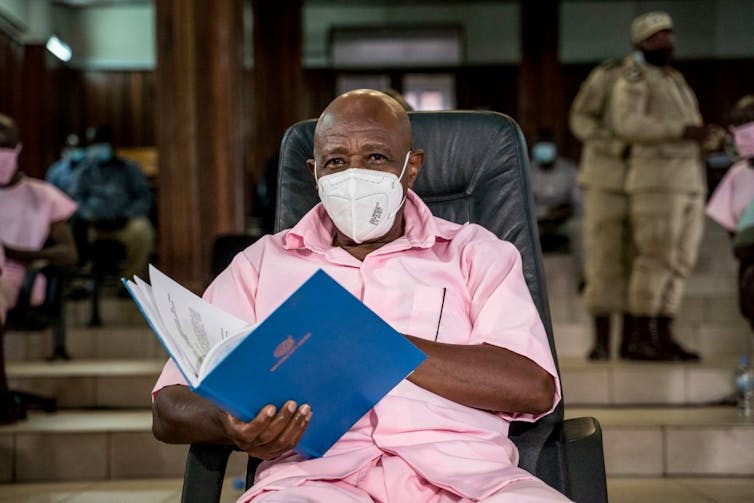
Paul Rusesabagina at the Supreme Court in Kigali, Rwanda, in February 2021. Simon Wohlfahrt/AFP via Getty Images

Jonathan Beloff, King’s College London

Paul Rusesabagina is perhaps one of the world’s best known Rwandans. His actions during the 1994 genocide against the Tutsi were made famous in the 2004 Hollywood film Hotel Rwanda.

The film was inspired by what happened inside Hotel des Mille Collines in the capital, Kigali. Here, 1,268 Rwandans, both Tutsis and Hutus, were saved from genocidal forces waiting beyond its walls.

The film depicts Rusesabagina – who left Rwanda in 1996 – as a hero who saved these lives. Following the film’s release, Rusesabagina received several humanitarian awards, including the US Presidential Medal of Freedom in 2005 from former president George W Bush. He eventually became a US resident and Belgian citizen.

On 27 August 2020, however, Rwandan officials arrested Rusesabagina. Human Rights Watch accused the Rwandan government of intentionally misleading him into a flight to Kigali.

The government accused Rusesabagina of supporting anti-Rwanda groups. He was charged with terrorism, arson, kidnapping and murder over two attacks in 2018 that killed nine Rwandans. On 20 September 2021, Rusesabagina was convicted of these charges. He was sentenced to 25 years in prison.

Since his conviction, Rwanda has rebuffed growing international pressure for Rusesabagina’s release.

In August 2022, during a visit to Kigali, US secretary of state Antony Blinken urged the government to release Rusesabagina. In Hollywood, actors and actresses have highlighted the issue through a “Free Rusesabagina” clothing campaign.

In my most recent research paper, I focused on the Rusesabagina case. Based on interviews with Rwandans, I conclude that Hollywood’s interpretation of historical events significantly differs from those who lived in the hotel during the genocide.

Hotel Rwanda is a double-edged sword for the country.

On one hand, it introduced the horrific 1994 genocide to a world that knew little of what had happened in the small African nation. Over 100 days between 6 April and 19 July, Rwanda witnessed the deaths of up to one million Tutsis and moderate Hutus.

On the other hand, the film’s historical inaccuracies built up Rusesabagina’s profile. Based on what I found during the course of the interviews I did, I argue that he used his fame to promote his version of Rwandan history and his desire for political power. My research findings echo those of others, including Rwandan academics, who have explored the mismatch in narratives.

Many in the global north, whose primary knowledge of Rwanda consists of the film, were swayed to Rusesabagina’s rather than Rwandans’ expression of their history, goals and desires. This narrative was driven to a large extent by human rights groups, which have been highly critical of the country’s human rights record.

Differing narratives

Between 2008 and 2018, more than 100 Hotel des Mille Collines survivors discussed with me their historical experiences and belief that Rusesabagina was not the reason they were still alive. I conducted most of these interviews at the hotel and the Kigali Genocide Memorial, which houses the remains of more than 250,000 genocide victims. My research also used existing networks within the Rwandan government and civil society organisations.

Survivors who were at the hotel said Rusesabagina ran the hotel as a personal profit-making venture.

If one could not pay him, one would face expulsion from the hotel’s grounds, which meant certain death. One survivor said:

If you could pay, you would stay in a room. If you couldn’t pay for a room, you could pay to stay in a hallway. If you couldn’t pay that, you could pay to stay by the pool. If you couldn’t pay that, he (Rusesabagina) would demand you to leave.

One hotel worker told me this:

He (Rusesabagina) didn’t care about any of us (workers). I begged him to let them (my family) stay as I was working there (at the hotel) for a long time. He didn’t care and demanded I pay him money or he would throw them out to be killed.

Several other survivor stories suggest a different narrative from the one in the film. In Hotel Rwanda, Rusesabagina is depicted as collecting money only to pay off genocide perpetrators.

Rusesabagina during the genocide

Prior to the genocide, Rusesabagina worked at the neighbouring Hotel des Diplomates. He took over the management of Hotel des Mille Collines after discovering that its European manager, Bik Cornelis, had been evacuated. One former hotel worker told me:

…a few days into the killings, Rusesabagina walked in one day and saw that the old manager (Cornelis) was taken with the other Europeans. He called (the hotel owners) and told them to … only work with him. They had no idea what was going on and probably hadn’t talked to Cornelis yet, so they agreed.

While the film credits Rusesabagina with creating an oasis during the conflict, he’s not the reason the hotel – one of the few areas offering refuge at the time – survived attacks from those behind the genocide.

Not depicted in the film are the seven to 10 United Nations Assistance Mission in Rwanda (UNAMIR) soldiers who were constantly positioned in front of the facility.

In his book, Roméo Dallaire, a former commander of this UN mission, says he stationed troops at the hotel’s only entrance as a symbolic indication that it was under the UN’s protection. Dallaire has spoken out against Hotel Rwanda as historical revisionism.

Further, the Interahamwe, the primary Hutu death squads responsible for the genocidal killings, had been directed to stay outside the walls of the hotel. They allowed people to run into it, but would threaten or kill those who tried to leave.

One former Interahamwe who had been stationed about 20 metres from the hotel’s entrance told me that he received instructions from his regional commander to “just stay put by the hotel and to allow the Tutsis and others to have access”. The hotel was also used for prisoner exchanges “and it would be the final spot for us to cleanse (murder the Tutsis) once we beat the RPF (Rwandan Patriotic Front)”.

The Rwandan Patriotic Front, led by Paul Kagame, took control of the country in July, ending the genocide. The horrors of the 100-day period led to Rwanda’s focus on forming a new single ethnic identity: “Rwandan”.

Jonathan Beloff, Postdoctoral Research Associate, King’s College London

This article is republished from The Conversation under a Creative Commons license. Read the original article.

Categories
Uncategorized

Rwanda and DRC’s turbulent past continues to fuel their torrid relationship

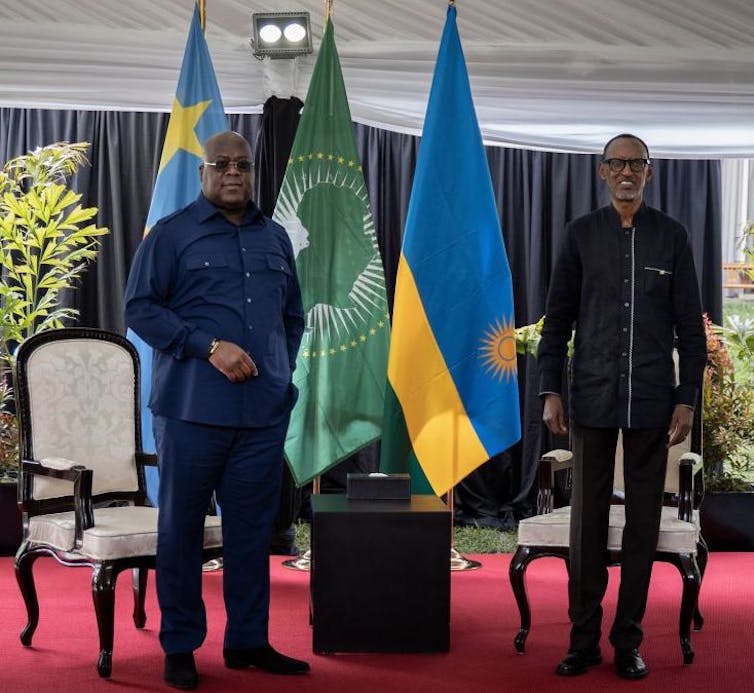
DRC President Félix Tshisekedi (left) and Rwanda President Paul Kagame in Kigali in 2021. Habimana Thierry/Anadolu Agency via Getty Images

Jonathan Beloff, King’s College London

Rwanda and the Democratic Republic of Congo (DRC) make for very unhappy neighbours. Both sides claim the other is set on bringing down their government, and violating past agreements and international norms.

Rwanda accuses the DRC of working with the Forces Démocratiques de Libération du Rwanda (Democratic Forces for the Liberation of Rwanda) or FDLR. The rebel group’s stated aim is to overthrow the Rwandan government.

For its part, the DRC accuses Rwanda of violating its sovereignty by supporting the Mouvement du 23 Mars (March 23 Movement, M23). The rebel group, along with multiple others, is active in the DRC.

A recent United Nations report supports Kinshasa’s contention. The group of experts on the Democratic Republic of Congo detailed its accusations in a 131-page report. Kigali, however, dismissed the findings as “false allegations”.

Rwanda is a country of 13 million people and occupies 26,000 square kilometres. DRC, on the other hand, has 90 million people and covers a territory of 2.3 million square kilometres. The DRC lies to the west of Rwanda. The two countries share a border of about 217 kilometres. https://datawrapper.dwcdn.net/rFkmp/2/

Tensions between the two nations date back to the 1994 genocide in Rwanda when an estimated one million Tutsis and moderate Hutus were killed. Many of the perpetrators of the violence fled to the DRC, at the time called Zaire. The post-genocide Rwandan government launched military operations in a bid to force the perpetrators back home to face justice.

Rwanda believes the DRC continues to provide refuge for those behind the 1994 attack.

The two countries have gone through two major wars and multiple skirmishes. They have also had periods of stability and trade growth. The latest tensions, however, are cause for concern. They risk destabilising the Eastern Africa region, disrupting trade routes and allowing for the establishment of opportunistic militia groups.

The issue is on US Secretary of State Antony Blinken’s agenda as he tours three African nations in August 2022. He will meet with Congolese and Rwandan leaders to negotiate for a peaceful resolution to the current conflict.

But, based on a decade of research into relations between the two countries, I do not believe Blinken’s visit will to lead to any significant reduction in tensions. The most recent events are not new. Both nations hold old suspicions of each other.

How it started

Since the 1994 genocide, the Rwandan government has kept a close eye on DRC. While 4 July is marked in Rwanda as the day the genocide ended, it was a temporary pause.

After two years of inaction from the then Zaire president Mobutu Sese Seko, Rwanda went after those it believed were behind the attacks and were hiding in Zaire. It carried out military operations that triggered the First Congo War (1996-1997).

This war had two objectives. The first was to disband the refugee camps that were hosting the remnants of the genocide perpetrators. An estimated two million refugees were forced back into Rwanda.

The second objective was the removal of Mobutu on the grounds that he was providing a haven for genocide actors. The Zairian dictator was removed from power in May 1997.

Within nine months, the war was over. With Rwanda’s support, Laurent Kabila and his Alliance des Forces Démocratiques pour la Libération du Congo-Zaïre (Alliance of Democratic Forces for the Liberation of Congo, AFDL) took over power.

But a much bloodier Second Congo War (1998-2003) soon followed. This was catalysed by two events. First, the dismissal of the Congolese defence minister James Kabarebe, who was Rwandan and largely responsible for conducting the First Congo War. Second, Congo’s support for the remnant genocide forces, Armée pour la Libération du Rwanda (Army for the Liberation of Rwanda, ALiR).

The Second Congo War dragged on for five years. It led to the deaths of millions of people. This was as a result of the actual fighting, and the increase in disease and malnutrition.

The lack of a quick resolution to the war resulted in various parts of the DRC being run by either militia groups, or the governments of neighbouring countries. Even allies during the start of the war, such as Uganda and Rwanda, fought against each other.

Eventually, the 2002 Pretoria agreement led to the withdrawal of the Rwandan military from Congolese territory.

Nevertheless, Rwanda continues to contend that Congo supports genocide remnants, now operating as the FDLR.

For its part, DRC accuses Rwanda of supporting Congolese rebel groups, such as the Congrès National pour la Défense du People (National Congress for the Defence of the People, CNDP) and the M23.

Divisions in Kigali

The Rwandan government is divided on the future of relations with its giant neighbour.

One group of policy leaders perceives the DRC as a continual threat to Rwandan security. They view the Congolese military as being ineffective in combating forces stationed in the DRC that are expressly against the Rwandan government, such as the FDLR.

This group often dominates public policy decisions in Rwanda’s foreign relations with the DRC.

But there’s a second group that focuses on the economic opportunities of closer Rwandan-Congolese relations. They believe that Rwandan development should focus on the export of domestically produced goods to the Congolese market of 90 million potential customers. Many within this group believe that the economic benefits outweigh the security concerns, which they argue have decreased in recent years.

Following the 2018 election, which saw Félix Tshisekedi become Congolese president, relations between Rwanda and the DRC improved. This included increased trade activity between the two nations.

It seemed for a while that the beliefs of Rwandans who wanted rapprochement with Kinshasa had the upper hand, hinting at a positive future for the two nations.

But in recent months, these hopes have been dashed. Once more, the dominant narratives involve allegations of DRC collaborating with the FDLR, and Rwanda with M23.

The two countries are likely to continue experiencing periods of stability and tension. Another major conflict, like the Congo wars, is unlikely, but the continual tensions prevent trade integration that would boost development and peace between the two nations.

Jonathan Beloff, Postdoctoral research associate, King’s College London

This article is republished from The Conversation under a Creative Commons license. Read the original article.

Categories
Uncategorized

The US and Rwanda: how the relationship has evolved since the 1994 genocide

Rwandan president Paul Kagame speaks during a governance event in the US. Paul Marotta/Getty Images

Jonathan Beloff, King’s College London

One of the primary points of discussion between Antony Blinken and Rwandan president Paul Kagame in the US secretary of state’s upcoming visit to Kigali will be the renewed tensions between Rwanda and its neighbours, particularly the Democratic Republic of Congo (DRC).

According to a US state department statement, Blinken’s visit will focus on the role the government of Rwanda can play in reducing tensions and the ongoing violence in eastern DRC.

Tensions between Rwanda and the DRC are running high. The DRC has accused Rwanda of openly supporting the Mouvement du 23 Mars (March 23 Movement, M23) in eastern Congo. Rwanda has dismissed these accusations. It has instead claimed that the Congolese government is spurring violence against the minority Banyamulenge population, and working with the rebel group called the Democratic Forces for the Liberation of Rwanda, which holds pro-Hutu genocide ideology.

Regional actors, such as Kenyan president Uhuru Kenyatta, have tried to reduce these tensions. But there has been little progress.

The issue is of importance to the US based on its historical relationship with Rwanda and its past alleged interference in eastern DRC by supporting antagonist forces, such as the M23. The charge was laid by the UN Group of Experts.

It’s unclear if Blinken’s mediation efforts will be successful.

Relations between the US and Rwanda have had their high and low periods. One of the lowest points came in 2012, during Barack Obama’s tenure as US president. He cut military aid to Rwanda over Kagame’s human rights record, as well as Kigali’s role in supporting the M23 rebel group. The US cut $200,000 from a $200 million programme, a symbolic gesture from one of Rwanda’s staunchest defenders.

Since then, Rwandan-US relations have continued to grow, with a notable increase of American tourists and officials visiting the East African nation prior to the outbreak of the COVID-19 pandemic.

The ups and downs

Before the Rwandan genocide against the Tutsi in 1994, the country fell within France’s sphere of influence. Washington did not view Rwanda as a strategic partner.

But the US’s relations with Rwanda changed after the genocide, based on a desire to help support the new post-genocide government. The result was the forging of close diplomatic relations, a process described by Robert Gribbin, a former American ambassador to Rwanda (1996-1999), in his book, In the Aftermath of Genocide: The US Role in Rwanda.

Gribbin sets out how the US developed close relations with the post-genocide government and the victorious Rwanda Patriotic Front. This included providing military training for soldiers and commanders, which still continues.

Thanks to the efforts of former assistant secretary of state for African affairs Susan Rice (1997-2001) under the Clinton administration, the US became a close ally of Rwanda.

This relationship held despite turbulent times under the Obama administration (2009-2017), which led to a reduction in military aid and harsher critiques of Rwanda’s democratic and human rights record.

While there was some optimism about the Trump administration, disagreements on trade led to anger among Rwandan officials.

Nevertheless, Rwandan-US relations have remained relatively strong.

Kagame as a pull factor

Possibly the reason for America’s continued close relations with Rwanda stems from the stability of Kagame. First appointed as president in 2000, he presents a stable ally who knows the pro-western language of development and security.

Kagame, however, has come in for a great deal of criticism for his domestic human rights and political record. Blinken, according to the US State Department, will be raising concerns about this record during his visit.

Blinken will particularly focus on Kagame’s “transnational repression, limiting space for dissent and political opposition, and the wrongful detention of US Lawful Permanent Resident Paul Rusesabagina”. Rwanda sentenced Rusesabagina to 25 years in prison for his connection to terrorist attacks in 2021 that killed nine Rwandans.

For the most part, however, American officials have chosen to overlook concerns about Kagame’s human rights record. They are much more inclined to view Kagame’s support as instrumental to promoting American policies and interests in Africa. These include promoting a business environment that is favourable for US foreign investment, his soft power influence in African relations and Kigali’s peacekeeping contributions.

Peacekeeping

America’s willingness to send its military into peacekeeping missions was greatly hindered by the 1993 failed peacekeeping mission in Somalia. The US was seen to have been humiliated after 19 American soldiers died in the Battle of Mogadishu.

These events fostered great political backlash in the US. Many Americans failed to see the purpose of sending US military personnel in non-strategic military operations.

America’s reluctance to be involved in peacekeeping opened the door for Washington to offer nations political, diplomatic and military support in return for their participation in missions. In this way the US could meet its commitment to peacekeeping without sending its own soldiers.

There is no doubt that Blinken will seek Rwanda’s continued commitment to contributing military and police personnel.

This is a particularly tricky issue in the region at the moment. Over the past two weeks, the UN peacekeeping mission in the DRC has come under attack. In two separate incidents, at least 20 people have been killed. Among them were three peacekeepers. Additionally, Rwandan authorities have previously threatened to remove their soldiers from peacekeeping missions after receiving international criticism.

Investment destination

Even though Rwanda is a small country – it is a low-income economy with a population of just over 13 million – it is still an important destination for American multinational corporations seeking to invest in East Africa.

Rwandan officials, in particular Kagame, have developed close relations with international leaders of companies like Starbucks, Volkswagen, Costco, Macy’s, Visa and Marriott International Inc.

These companies have either opened factories, such as Volkswagen, bought commodities, such as Starbucks, or as with Visa, invested in financial growth services in the region.

Outcome

The current tensions between the DRC and Rwanda, as well as the holding of Rusesabagina, will not be solved by Blinken’s quick visit. But these issues are unlikely to cause any long-term damage to Rwanda-US foreign relations.

Jonathan Beloff, Postdoctoral research associate, King’s College London

This article is republished from The Conversation under a Creative Commons license. Read the original article.

Categories
Uncategorized

The Foreign Policy Benefits of Refugees and Migrants: the United Kingdom, Rwanda and Refugees

On April 14, 2022, the Home Secretary for the United Kingdom, Priti Patel, alongside Rwandan foreign Minister, Vincent Biruta, announced an agreement between the two nations unlike anything before. The agreement contains a controversial arrangement that will see UK-bound refugees and migrants being transferred to Rwanda while their claims for refugee status are reviewed. Rwanda will not only house these refugees but will also provide them opportunities for education and jobs, access to health care facilities and security from harm. While there are official claims that refugees are not simply being deposited and forgotten in Rwanda, Minister Biruta’s comments illustrate an underlying goal of permanent settlement for the refugees. For this great undertaking, Rwanda’s government will receive an estimated £120 million. Much of this money will be for the refugees and migrants but it will also be used by the Rwandan government to help fund other social programs. Many human rights organisations such as the United Nations Refugee Agency (UNHCR) and Human Rights Watch have condemned the agreement. Even within Rwanda, there has been some opposition to the deal. The announcement has Rwanda becoming a new target of anger towards UK Prime Minister Boris Johnson.

There is a major question missing in much of the news media coverage within the United Kingdom and the Global North: why is Rwanda doing this? Why is a small African state taking in refugees and migrants from another country thousands of miles away?

For those unaware, Rwanda is a small African nation, roughly the size of Belgium, in the African Great Lakes region with over 12 million people. Its GDP is roughly USD 10.33 billion with a GDP per capita of just under US$800. The landlocked nation is best known for its horrific genocide, the 1994 Genocide against the Tutsi, which witnessed an estimated 1 million Tutsis and non-extremists Hutus killed within a 100-day period. Despite the presence of an international peacekeeping force, the United Nations Assistance Mission in Rwanda (UNAMIR), the mass killings only stopped when the Uganda-based rebel group, the Rwandan Patriotic Front (RPF), overthrew the genocide government. The RPF has remained in power since the genocidal killings, which it commemorates during Kwibuka ceremonies. The country has been praised for its market-oriented economic policies which experienced impressive economic growth.

1.)   The Importance of History:

Many Rwandans’, at least on social media, reactions within the first hours of the refugee agreement were positive. The issue of migration and refugee identity is important to many who were at one point or another, refugees. Starting from the 1959 Hutu Revolution, many Rwandan Tutsis and some Hutus were forced to flee their homes into neighbouring nations. Countries such as Zaire (now the Democratic Republic of Congo), Uganda, Tanzania and Burundi experienced waves of Rwandan immigrants fleeing pogroms, government institutionalised racist restrictions and threats to their lives. Despite this initial wave of refugees, there would be several other migration waves. Even after the 1994 genocide, Rwandans, mostly Hutus who feared retaliation for the genocide, fled to neighbouring Zaire only to be repatriated during the First Congo War (1996-1997). It is difficult to travel to Rwanda and find someone who has never been or known personally a former refugee.

Nevertheless, the attention of this article is on the first wave of refugees who travelled to Uganda as they compose much of the post-genocide Rwandan government. The previously mentioned RPF were largely, but not exclusively, composed of these refugees. Once the genocide ended, hundreds of thousands, if not one million, returned to help rebuild Rwanda. While the RPF has been in power since 1994, many of these former refugees hold important government and economic positions. Rwanda’s previous experience with migration influences not only many Rwandans but also policymakers. This has led to a relatively positive belief that refugees should be welcomed and supported as a way to correct past wrongs. A similar response can be seen in Rwanda’s peacekeeping. Rwanda’s military and police are significant contributors to global peacekeeping missions around the world based on historical experiences of UNAMIR’s failures to prevent and stop Rwanda’s genocide. (I will address this topic a bit more later on.) Nevertheless, many Rwandans are more inclined to welcome these refugees and migrants because of their past refugee experiences.

2.)   Agaciro

Found within Rwanda’s pre-colonial period are societal beliefs that trickle into much of Rwandan life and policy. One of these beliefs is the agaciro, which can loosely be understood as an indigenous version of Max Weber’s Protestant work ethic combined with terms of self-reliance and dignity. While the term has often focused on economic issues, I have applied it to the concept of Rwandan foreign relations. I argue that the concept is paramount in understanding why the Rwandan government desires to reduce foreign aid reliance on donors, relying on other nations for security and as a tool to attract foreign direct investment (FDI). However, the term should be used to explain why Rwanda and its government would agree to take in UK-bound refugees and migrants.

The Rwandan government wishes to reconstruct the national identity away from the previous regimes’ use of ethnic divisionism among Hutu, Tutsi and Twa to formulate a new one of ethnic and national unity of Ndi Umunyarwanda meaning ‘I am Rwandan’. Utilising the agaciro belief, the Rwandan government is attempting to instil a greater sense of national pride as a humanitarian rescuer for mistreated migrants. This is not only found in the nation’s peacekeeping efforts, but it also has an audience with a Rwandan population that has experienced being a refugee. This greatly fosters the concept of the caring Rwandan taking in suffering people. It also illustrates how Rwanda is proactively trying to benefit others by accepting these refugees rather than ignoring their plight. More importantly, Rwandans will see this agreement as a form of foreign praise by the UK government recognising Rwanda’s previous work assisting refugees from Burundi and the DRC. Overall, the agreement boost national pride as it will be described as fulfilling the agaciro belief.

3.)   £120 Million is a lot of Money:

While much of the Global North faces the economic consequences of the Covid-19 virus, the virus’ consequences on the Global South are often ignored. The pandemic greatly harmed Rwanda’s tourism sector which composes a majority of foreign income and a large section of the overall economy. While we will not know the true economic effects of Covid-19 for some years, the nation’s economic growth was seriously impacted. Before the pandemic, Rwanda’s economy was annually growing at around 9 per cent. In 2020, the economy retracted by over 3 per cent. The microeconomic consequences impacted most, if not all, Rwandans. The promised £120 million provides great budgetary support that will benefit beyond the refugees.

In terms of how the money will be spent, the two leaders stated how the funding will also be for, “the UK’s upfront investment of £120 million will fund opportunities for Rwandans and migrants including secondary qualifications, vocational and skills training, language lessons, and higher education.” It is important to note that while much of the money will be spent on the incoming refugees and migrants, there will be excesses that will benefit Rwandans. This includes the economic productivity of these migrants, whether they create new opportunities and settle or those who will just spend their UK-provided financial resources residing in Rwanda. For Rwandans, these migrants might fall within what the Economist Milton Friedman described as the economic benefits for society spanned by increased immigration.

4.)   The Foreign Policy advantage:

Much of the literature on Rwanda’s foreign policy is constrained by the genocide guilt card narrative. The narrative reduces much of Rwanda’s foreign policy as the government utilises the guilt of the international community’s inactions to prevent or stop the genocide for national gain. This often is done when deflecting domestic or regional human rights violations. While the theory has declined in recent years, it nevertheless still resides as a catch-all to describe how the Rwandan government perceives and engages with the international community. I argue within my research how the guilt card narrative is not only problematic but intentionally or unintentionally ignores the beliefs and perceptions of Rwandan policymakers.

While the guilt card narrative has declined in its usage, aspects of it can still be found. In 2010, former Foreign Minister Louise Mushikiwabo threatened the removal of Rwandan peacekeepers in response to UN reports criticising Rwanda for interfering in the neighbouring DRC. The threat to remove the much needed Rwandan peacekeepers was akin to the guilt card as it relied on the emotions (guilt and desire not to send soldiers from the Global North) of international actors for political gain. Not surprising, many Rwandan policy leaders expressed to me their support for continued Rwandan contribution to regional and global peacekeeping regardless if they felt undue international criticism. Nevertheless, peacekeeping seems to have become a political mechanism within the nation’s foreign relations.

The new UK-Rwandan refugee agreement could become a new tool within the toolbox of Rwandan foreign policy. It should not come as anyone’s surprise if the Rwandan government brings up the migrant deal as a way to deflect criticism when the UK criticises the Rwandan government’s handling of domestic issues in the future. Despite any and all good-hearted reasons, Rwanda is accepting UK-bound refugees and migrants because Prime Minister Johnson and his government promised to reduce immigration in the United Kingdom. This is huge political leverage that will benefit Rwanda’s positioning when dealing with the UK in the future.

Conclusion:

The UK-Rwandan agreement on migrants and refugees is a huge announcement in a world in which xenophobia has greatly increased. While criticism of the agreement is justified, the focus should be on their political leaders rather than Rwanda. Home Secretary Patel has claimed this decision was based on her desire to reform UK immigration laws and combat human traffickers but there has been significant pushback. Oppositional groups as well as religious and human rights leaders have largely condemned the deal and dragged Rwanda into the British political divide. Often missing within these narratives and examinations is why Rwanda would accept these refugees. For Rwanda’s government, the agreement not only benefits the economy but also promotes the agaciro belief. It also provides a new policy tool for the Rwandan government when engaging with the international community.

Categories
Uncategorized

Rwanda seeks political gains from peacekeeping

A review for Oxford Analytica of Rwanda’s 2021 peacekeeping contribution in Mozambique.

Link: https://dailybrief.oxan.com/Analysis/DB262950/Rwanda-seeks-political-gains-from-peacekeeping

PDF: