Categories
Uncategorized

When did the Genocide against the Tutsi end?

Every July 4th, Rwanda commemorates the end of the Campaign against Genocide War in Kigali. It was on this date in 1994 that the Rwanda Patriotic Army (RPA) gained control over Rwanda’s capital after the retreating Rwandan Armed Forces (FAR) fled. But the final weeks of the war in Kigali witnessed the FAR and genocidaires, such as the Interahamwe, lose much of their control to the RPA. Nevertheless, it was the late evening of July 3rd when the remaining forces at Camp Kimihurura, Camp Kacyiru, and Mt Kigali fled the city, going north. While Lt General (Rtd) Charles Kayonga, commander of Bravo CMF at the time, along with 7th CMF, followed the retreating soldiers, fighting continued.

During much of the Campaign War, most of the RPA’s forces and resources focused on Kigali. While the genocide regime, created shortly after the death of former Rwandan President Juvenal Habyarimana, based itself in Gitarama (April 16th) rather than Kigali, the city still held significant political, economic, and military importance. Within military studies, the city was the centre of gravity for the war. Additionally, during much of the fighting, many Rwandan Tutsis and non-extremist Hutus hid at locations such as St Andres, Amahoro Stadium, St. Paul, St Familie, and other places, waiting to be rescued.

Outside of Kigali, several RPA’s CMF fought throughout the hilly nation, such as the 101 (under Lt General (Rtd) Charles Muhire); 157th (under General (Rtd) Fred Ibingira); 7th (under Colonel William Bagire) and Charlie CMF (under Colonel Thadee Gashumba). However, these CMF focused on different areas with the 157th fighting across much of the east, south, and west of the nation. This is not to minimise the contribution of the other units. For instance, Charlie CMF focused its fighting in the Musanze region. Without Lt General (Rtd) Charles Muhire’s 101 CMF, much of southern Rwanda would not have been militarily secured. The mobile force even played a significant role in the capture of Gitarama on June 13th. The 7th CMF played a significant role in capturing the eastern neighbourhoods of Kigali, which aided in the capture of Camp Kanombe in late May.

As I argue in my recent book, The Strategy to End the Genocide against the Tutsi in Rwanda: Understanding the War in Kigali, the RPA’s central strategy was to end the Genocide against the Tutsi. To reach this strategic end, the RPA conducted military and humanitarian operations through various tactical methods. Stopping the genocide’s wrath was so important that the RPA at times risked military objectives in order to save Rwandans. Every force involved in ending the genocide received clear orders from its commander-in-chief, current Rwandan President Paul Kagame, to focus on saving lives even at the expense of military targets. For those mobile forces in Kigali, this was difficult in the urban setting. Those fighting outside Kigali did not have an easier time reaching this objective. Whenever I travel around Rwanda, I make it a point to reach out to former soldiers of the 157th CMF. I often express to them how I am in disbelief that they have liberated such a large and hilly environment in such a short time.

But there has always been a question I have asked myself, or others have asked me. When did the Genocide against the Tutsis really end? While many within the Rwandan government publicly stick to the July 4th date, other critical dates should be considered.

When Gisenyi fell on July 18th:

    After the FAR fled Kigali during the evening of July 3rd and early 4th, many used the Kigali-Musanze route to escape. The RPA allowed the accessibility of the passageway for the retreating soldiers. This might lead to some serious questions about RPA military strategy. After all, why grant these forces the ability to flee? However, it becomes clear when studying the RPA’s military tactics, operations, strategy, and other relevant aspects. President Kagame had at times created ‘humanitarian zones’ for civilians loyal to the genocide regime to escape the upcoming battles. (This contrasted with the FAR, which would often leave weapons behind for Interahamwe to continue their genocidal killings or kill any remaining Tutsi during the RPA’s approach.) For instance, before the battle for Camp Kanombe, President Kagame ordered Lt Col. (Rtd) Jacob Tumwine to establish a corridor just south of Kanombe for any forces or civilians to escape the upcoming battle.

    This falls in line with the encirclement tactics employed by the RPA, which focused more on creating confusion, decreasing enemy morale, and forcing them to flee (often leaving military equipment behind). This was the perfect response to what Minister of Defence Brigadier General Juvenal Marizamunda classified as ‘defensive military tactics’ that originated from the FAR’s close relationship with French forces. Whenever the FAR retreated, they rarely counterattacked but instead established newer, but weaker, defensive positions. During each retreat, the FAR’s morale declined, the RPA collected abandoned weapons, and planned a new strike. Thus, allowing the retreating FAR to use this corridor should be seen within the constructs of the RPA’s tactics and overall strategy.

    The retreating FAR, which travelled north, would eventually be pushed into eastern Zaire, now the Democratic Republic of Congo (DRC) by July 18th. The following day, a new government designed by a modified version of the Arusha Accords was sworn in. However, the RPA did not have control over all of Rwanda. Many fleeing FAR travelled southwest by the end of the war, which was under Opération Turquoise. Nevertheless, July 18th is another date that could be considered as the end of the Genocide against the Tutsi.

    End of Opération Turquoise on August 21st:

    After the arrival of Alpha CMF under Major General (Rtd) Samuel Kaka to the Rwandan Parliament on April 12th, uniting with Lt General (Rtd) Charles Kayonga’s 3rd Battalion (better known as ‘The 600’), the FAR had little chance of winning the war. While they would continue fighting, thus allowing the Interahamwe time to murder Tutsis and non-extremist Hutus, the FAR never had the organisational structure, military expertise, morale, or clear strategic goals. Many took the opportunity to either participate in the genocidal killings or to profit from the chaos. This is not universal, as those such as Minister Juvenal Marizamunda, Major General (Rtd) Albert Murasira, and Brigadier General Evariste Murenzi, among others, served the FAR and/or fought the RPA but did not participate in the genocidal killings. Thus, their integration into the new Rwandan military after the war was possible despite them joining at different times and through very different circumstances.

    Minister Juvenal Marizamunda was one of the FAR members who had travelled to the zone under Opération Turquoise during the waning months of the Genocide. He had spent much of the war in France for military training, but returned to find his family. Opération Turquoise provided him the ability to reconnect with family who resided in southwestern Rwanda. Unlike Minister Marizamunda, who did not participate in any genocidal killings, many within the FAR took the opportunity to continue waging their genocidal war against the Rwandan Tutsis.

    By June 19th, France, which held close relations with the former Habyarimana regime, announced the creation of a multilateral force consisting of roughly 2500 French, Senegalese, and other fighters. Under French control, with UN Security Council approval, these forces created a zone in southwestern Rwanda, occupying nearly a fourth of the country. On the surface, this zone would be for those seeking peace away from the violence. The reality indicated a somewhat different objective with accusations of French support for the retreating FAR. During the days following the announcement of Opération Turquoise, the territory still held by the FAR and the genocide regime was celebrated. Akin to earlier on in the Liberation War (1990-1993), French forces aided the struggling FAR to push back the RPA. However, the FAR quickly realised these French forces were not there to fight the RPA.

    Nevertheless, the RPA command was quickly prepared, through the 157th CMF, to fight these new forces. As General (Rtd) James Kabarebe commented during a 2023 conversation, the RPA began constructing military defensive bases to prepare for a new war. Thankfully, that never materialised. By August 21st, Opération Turquoise ended with many of the FAR and actors within the genocide regime able to cross into Bukavu, Zaire. Some question, such as Prunier, whether Opération Turquoise was France’s attempt to save their faltering allies.

    Why consider August 21st as the end of the Genocide against the Tutsi? One of the controversial outcomes of Opération Turquoise was how it both saved and killed Rwandan Tutsis. While Bisesero is perhaps the best-known example of killings in this region, many testimonies exist of those who became victims thanks to the French forces. Many Rwandans who were in hiding since the beginning of the genocide began to leave their hideouts once they saw the foreign troops. Some believed they were either part of the United Nations Assistance Mission in Rwanda (UNAMIR) or another peacekeeping force. Thus, they believed the massacres were over. However, the French forces often did not disarm the Interahamwe and allowed them to still carry out their massacres. Rwandans who had spent the last few months in hiding were now an open target.

    By August 21st, the French forces left, and the RPF immediately took the region. Thus, the last genocidal killings in Rwanda that continued during Opération Turquoise were now over.

    First Congo War:

    While conducting my PhD research on Rwandan foreign policy, I had the opportunity to meet Rwanda’s former military historian.[1] He said something rather interesting to me about the First Congo War (1996-1997). From August 1994 until October 1996, the former FAR, Interahamwe, and genocide regime restructured in eastern Zaire. Akin to Hamas’ use of Gaza civilians, the refugee camps were a way to be protected from responsibility; use international attention to the plight of the refugees as a political tool, and require aid agencies to pay taxes to the government-in-exile for access to the civilians. While using the cover of nearly two million Rwandan refugees, they conducted raids into Rwanda, often being bloody. These near-constant attacks led to the inevitable decision to invade eastern Zaire to remove the refugee camps. Despite criticisms by human rights organisations, former US ambassador to Rwanda Robert Gribbin called the refugees’ return to Rwanda orderly with little violence.

    By December 1996, most of the refugee camps were dismantled. Many refugees returned to Rwanda with those from the FAR, Interahamwe, and genocide regime facing a choice: fight, flee deeper into the jungles, or return to Rwanda. Those such as Minister Juvenal Marizamunda decided to return home and join the new military, which later became the Rwanda Defence Force (RDF). However, many fled deeper into the jungles, leading most to their deaths. Those who survived continued to fight against Rwanda, in a significantly diminished capacity, created the Army for the Liberation of Rwanda (ALiR) and later the Democratic Forces for the Liberation of Rwanda (FDLR). Nevertheless, the dismantlement of the refugee camps resulted in a significant reduction in attacks against Rwanda by former genocide forces. The war continued until May 1996 with the overthrow of President Joseph Mobutu’s regime and the installation of Laurent Kabila as President. However, violence recommenced shortly afterwards.

    Did it ever?

    In 2013, while working at the National Commission for the Fight against Genocide (CNLG), now part of the Ministry of National Unity & Civic Engagement (MINUBUMWE), one could not escape Gregory Stanton’s description of the stages of genocide. Within his description of genocide are the expected categories, such as (in order): classification, symbolization, dehumanization, organization, objectification, preparation, extermination, and denial. This last element is key to the question of when the Genocide against the Tutsi ended.

    While any of the dates above can be considered as the end of the massacres, within Rwanda, the perception by many is that the genocide continues, but in a different form. Actors, mainly in the Global North, hijack ‘human rights’ or ‘democracy’ language as a cover to promote their genocidal ideology. Some forms of genocide ideology consist of outright denying the genocide, or trivializing the suffering, reducing numbers, or blaming the RPA. Many, such as in the FDLR, still proclaim their desire to return to Rwanda to finish the genocide. There are numerous elements within this category that Rwandan foreign policy addresses. There have been acts of terrorism and physical attacks by actors still holding the genocide’s ideology, such as Paul Rusesabagina’s Party of Democracy in Rwanda – Ihumure (PDR-Ihumure), responsible for killing nine Rwandans back in 2018. However, the primary threat that genocide denial and the ideology at its core pose is the ontological insecurity it produces, as it threatens Rwanda’s socially constructed norm of Ndi Umunyarwanda.

    Thus, some within Rwanda believe the Genocide against the Tutsi never ended, as there are actors who either want Rwanda to return to the genocidal massacres or deny what occurred in 1994.

    Conclusion:

    So, when did the Genocide against the Tutsi end? The July 4th date is the most well-known day, despite it commemorating more of a military victory in Kigali. Is July 18th the final day, as that is when the RPA captured the last major FAR-controlled territory? If this is the answer, then how does one account for those still dying in southwest Rwanda under Opération Turquoise? Fundamentally, the genocidal massacres continued in other parts of the country until they were under the RPA’s control. This does not ignore how some still died even after the RPA took a specific territory. The retreating FAR would often leave behind military equipment to Interahamwe, instructing them to wear civilian clothing and wait until the bulk of RPA forces left an area before returning to killing Tutsis. This led to RPA ‘clean-up’ operations to uncover and stop the Interahamwe. However, some human rights organisations mistook these operations as directed towards civilians rather than active genocidaires wearing civilian clothing. Did the dismantlement of the refugee camps during the initial months of the First Congo War end the genocide? The majority of surviving FAR, Interahamwe, and genocide regime after 1994 used these camps to launch attacks against Rwandans. The international community failed to disarm the camps until Rwandan forces did so in 1996. Lastly, did the genocide ever really end, as its ideology and denial still can be found today?

    Unfortunately, I do not have an answer to this question. While I often point to August 21st as the end of the physical genocide, its pain continues to this day. Whether in the form of denial or revisionism, the ideology that killed roughly a million Rwandan Tutsis and non-extremist Hutus remains today.


    [1] To keep focus on this article’s central question, when the Genocide against the Tutsis ended, I am avoiding diving into his situation.

    Categories
    Uncategorized

    Review: Modern Rwanda: A Political History

    Filip Reyntjens. Modern Rwanda: A Political History. Cambridge: Cambridge University Press, 2024. $30.99. Paper. ISBN: 9781009284486.

    Rwanda is perhaps best known for its experiences during the 1994 Genocide against the Tutsi, more commonly known as the Rwandan Genocide. Since the end of the genocide, researchers flocked to the small African nation to better understand what led to the massacres and how the society rebuilt itself. The level of success to which Rwanda rebuilds itself since the genocide is hotly debated. Reyntjens is perhaps one of the most known scholars and critics of Rwanda. Despite not visiting Rwanda since October 1994, he continues to write on Rwanda’s politics and human rights. His new book somewhat differs from much of his current research, focusing mostly on Rwanda’s pre-colonial and colonial history.

    The book is divided into seven chapters, excluding the Introduction and Conclusion. After the Introduction, the book’s first chapter examines the pre-colonial history of Rwanda. Reyntjens illustrates the complexities of this period of Rwandan history, which is mainly unexplored compared to the genocide but heavily debated within Rwandan studies. The current Rwandan government often describes this period as relatively tranquil, with no Tutsi, Hutu and Twa divisions. However, this chapter problematises this perception to indicate how not only did these ethnic divisions exist but also how the pre-colonial Rwandan state was not as united and uniform as described. The following two chapters explain how Germany and Belgium influenced and engaged with colonial Rwanda. The fourth chapter describes the final years of colonisation with the rise of the Hutu Revolution and independence. Despite somewhat minimising the human suffering during this period for Rwanda’s Tutsis, the chapter exceeds in clearly categorising the political turmoil and actors of the late 1950s and early 1960s.

    The final three chapters examine Rwanda’s political history since independence. The First (1962-1973) and Second (1973-1994) Republics are described in terms of historical narratives that do not focus on explaining the genocide. Rather, chapter five provides a purer form of political-historical analysis to understand that historical period rather than how it led to the genocide. Chapter six briefly examines the Rwandan Civil War and the genocide. The final chapter, before the book’s conclusion, contains Reyntjens’ harsh critiques of Rwanda since the genocide. His attention is not on describing the complexities of governance under the Rwanda Patriotic Front (RPF) as he did with ruling elites in the previous chapters. Instead, his focus is to repeat previously published claims of how the ruling RPF conducts human rights violations both inside and outside Rwanda. In all of the book’s chapters, his seventh chapter on Rwanda’s post-genocide governance feels the most disconnected from the rest as it lacks the same nuance as in previous chapters.

    While there is no doubt this book will be used as a major source on Rwandan politics, it does contain some issues that need to be at least mentioned. The majority of this book is unique in providing a relatively straightforward description of early Rwandan history, both before and during colonisation. However, many of its citations stem from somewhat older sources, with only a few exceptions, such as Jan Vansina’s 2004 book Antecedents to Modern Rwanda[1]. There is also an underlying problem in how Reyntjens seems to downplay the suffering that occurred during and after the Hutu Revolution against Rwandan Tutsis and others who did not align with the Hutu ideological movement during much of the country’s independence and up until the genocide. It reads as a setup to later try to criticise the RPF’s governance by establishing a narrative of how things are worse now in Rwanda than decades ago.

    His criticisms of present-day Rwanda read more like an overview of other research, as his lack of fieldwork experience severely limited the practical realities of the complex nature of Rwandan politics within the nation. Fundamentally, one can only write so much insight into the current political dynamics while writing from Europe. The book’s methodology is the first topic covered in the Introduction, but it never addresses the issues found in Chapter Seven, which is either an incomplete or problematic illustration of Rwanda today as it relies solely upon observations from afar rather than proper fieldwork.

    One of the primary claims made against Reyntjens by Rwandans is his involvement in the 1978 constitution. This constitution legitimised former Rwandan President Juvenal Habyarimana’s grip on power by establishing a one-party state along with the discriminatory quota system against Rwandan Tutsis. Supporters of the RPF often cite Reyntjens’ involvement in drafting the constitution with little supporting evidence. While reading the fifth chapter he does not address this accusation by writing, “space forbids a detailed analysis of the constitution” (page 114). This is despite him being a legal and constitutional specialist. However, in the following chapter, on page 146, he has space to write a subsection on the number of genocide victims. While this might seem a minor issue, it illustrates a missed opportunity for Reyntjens to refute some of the significant and damning claims made against him. It was an overlooked opportunity to provide a new element within his vast work on Rwanda.

    Reyntjens’ new book on Rwanda’s political history will undoubtedly be a much-used text in criticising Rwanda’s government and perception of the nation’s history. The book’s greatest strength is its clarity in describing the complex issues and history of Rwanda’s pre-colonial and colonial history. Its description of the political dynamics between former President Grégoire Kayibanda and Dominique Mbonyumutwa is unique in terms of clarity. However, the examination of modern Rwandan politics faces the issues found in his other publications, a lack of actual observational data collected from conducting proper fieldwork.


    [1] Jan Vansina, Antecedents to Modern Rwanda: The Nyiginya Kingdom, Madison: University of Wisconsin, 2004.

    Categories
    Uncategorized

    Remembering the Campaign against Genocide War

    On March 14th and 15th, I led a workshop at the Kigali Genocide Memorial examining how the Rwandan Patriotic Army (RPA) ended the Campaign against Genocide War. It was during April to July 1994 that the RPA fought military and genocide forces to put an end to the Genocide against the Tutsi. While the Genocide is perhaps one of the most well-studied subjects of Rwanda, how the genocidal massacres ended is less explored. How people survived often ends with the RPA coming and liberating a town, village or area from the genocide perpetrators.

    The project, funded by the Arts and Humanities Research Council (AHRC), utilised Strategic Theory and Military Studies to examine and understand the different operations and tactics used by the RPA. Beyond a historical examination and week-to-week exploration of military combat, it crafts the strategy held by both the RPA and the Forces Armées Rwandaises (FAR). Interviews were collected from not only those who fought in the RPA but included the FAR. Additional interviews with genocide survivors and a perpetrator also helped foster a picture of the hundred days in Kigali. The interviews are not the only source, as they were triangulated with UNAMIR reports and existing scholarly material.

    The research’s conclusions illustrate how the RPA’s central strategy was to end the Genocide. This differs from the works of Rwandan political critics and those with questionable ethical backgrounds, who accuse the RPA of not only igniting the Genocide but also helping fuel it with their massacres. However, their conclusions do not fit when understanding the RPA’s humanitarian and military operations and the tactics within those missions.

    Operations and Tactics:

    Humanitarian operations, often with just a squad (5-10) or platoon (15-20) of soldiers, focused on finding Rwandan survivors and bringing them to ‘safe zones’ that were already under the RPA’s control, such as Mt Rebero, Parliament (CND), Gisozi, SOS Children’s School and so on. Irregular or guerrilla tactics often aided in not just infiltrating genocide territory but to help remove Rwandans to the ‘safe-zones’ where they could later be taken out of the city and away from danger.

    Military operations were critical in the war as the institutional power of the genocide, the akazu-dominated genocide interim government received support and space from the FAR. By the final days of April, any non-extremist FAR officers with influence had been removed, allowing those such as General Augustin Bizimungu and Colonel Théoneste Bagosora to promote the FAR’s engagement in the genocidal killings. This does not deny how some members of the FAR opposed the military’s involvement in the Genocide. Many of them joined the RPA after the war. However, the FAR was the military protection that protected the genocide actors, such as the Interahamwe, from the RPA. For the RPA to end the genocidal massacres, the FAR needed to be defeated. Military operations included irregular and conventional warfare encirclement tactics, with urban combat often utilised in Kigali.

    If the RPA’s strategic goal consisted of only military victory, the humanitarian operations would either not occur or be the bare minimum akin to the Allied movements during World War Two. While the Soviets, US and British did liberate the concentration and extermination camps of Europe, their actions in helping survivors cannot be compared to the RPA. The RPA’s central focus was to save not Tutsis, Hutus or Twa but instead and, more importantly, Rwandans. RPA soldiers never asked for identity cards or ethnic identities during the operations. Military operations could even be harmed or overridden if there was a chance for a successful humanitarian operation. An example of this can be found before the Battle for Mt Rebero.

    Mt Rebero from Parliament

    Mt Rebero:

    Under the command of Lt Colonel Jacob Tumwine, RPA commander of Eagle and Simba Companies, he received orders from RPA General (now President) Paul Kagame to take the tactically important hill of Mt Rebero. During the late hours of April 11th, Lt Colonel Tumwine led his 300-man army, not nearly enough for the military operation, from the Parliament, the headquarters of the RPA’s 3rd Battalion, through the neighbourhoods of Gikondo and Kicukiro and up the southern hill. Unbeknownst to them, Belgian peacekeepers had previously abandoned the nearby Ecole International School (ETO). With FAR support, Interahamwe led a death march of over 2000 Rwandans up to Nyanza Hill to be slaughtered. By the morning of April 12th, Lt Colonel Tumwine’s scouts found the site of a massacre.

    Thousands of bodies lay dead, with a hundred or so survivors beginning for help. The Interahamwe had departed the area as night fell and planned their return to finish off the remaining victims in the morning. Lt Colonel Tumwine was confronted with a difficult choice. Does he help the survivors or not? Helping the survivors required leaving behind much-needed soldiers to guard them until they could be taken to safety. But Lt Colonel Tumwine barely had enough soldiers for the upcoming battle at Mt Rebero. If he chose to bring the survivors with him, he would lead them to a battlefield. The final choice was to leave them to their fate. But Lt Colonel Tumwine remembered the RPA’s strategy to ending the Genocide. He could not leave these survivors behind or put them in a position of harm. Thus, he left a platoon of soldiers behind, including one of his right-hand men, to protect them from genocide forces until they could be taken out of the area.

    His decision could have harmed the success of the military operation to take Mt Rebero. However, he would have violated the RPA’s central strategic goal if he did not help the survivors. This type of decision was not a one-off event, as nearly every soldier in the RPA faced this decision at one point or another, and it often occurred multiple times until the war ended.

    Conclusion:

    How the Genocide against the Tutsi ended is essential in understanding Rwandan history. Rwanda must remember how the battles, operations and decisions during the Campaign against Genocide War ended the Genocide. Throughout conducting this research, Rwandans often came and asked questions. They want to know how the Genocide ended beyond just the RPA won. They wish to know how the RPA did it and who led the specific operations in their neighbourhoods. How the RPA ended the Genocide against the Tutsi could only have occurred with its strategy of ending the Genocide. At the same time, the FAR, Interahamwe, akazu and their allies wished to promote the massacres.

    It was a privilege to interview many of those who ended the Genocide. It was fascinating to talk to and interview those who fought for the FAR but knew the evils that too many of their comrades were doing. Even those seemingly powerless to stop their commanders refused to engage in the massacres. Some resisted in whichever way they could by saving a few Rwandans when they could or resisting orders to kill Tutsis. Rwandans want and need to know about their history. In the near future, the collected data will be released with the support of the Kigali Genocide Memorial and as a book published by Lexington Books.

    Categories
    Uncategorized

    Faustin Twagiramungu: A Dinosaur of Rwandan Politics Long Gone

    On 2nd December 2023, the news broke on social media that Rwanda’s former Prime Minister Faustin Twagiramungu died in Belgium. While most Global North-based activists mourn his loss and make somewhat questionable claims of him being a ‘symbol of democracy’ for Rwanda, his loss in Rwanda will go relatively unnoticed. This brings up an interesting question of what happened to Twagiramungu in the consciousness of not just the Rwandan public but the new generation of Rwandans whose lives consist mainly after the Genocide against the Tutsi. Global North social activists will answer how minor mention of his death in Rwanda originates from President Paul Kagame or the Rwanda Patriotic Front (RPF). However, that is problematic as it does not reflect the realities in Rwanda.

    Who Was Faustin Twagiramungu?

    Born in 1945 in Cyangugu Province, Twagiramungu lived a relatively everyday life for a Rwandan Hutu. Since independence in 1962, Rwanda’s social norms favoured the majority Hutu (composing roughly 84% of the population) over the minority Tutsi (comprising approximately 15%) and the minority Twa (comprising less than 1%). The previous 1959 Hutu Revolution, promoted by the nation’s first post-colonial President, Grégoire Kayibanda, glorified Hutu supremacy. Mass pogroms led to thousands of Tutsi to flee into neighbouring countries. Over the coming years, anti-Tutsi pogroms left thousands dead and tens of thousands to flee into neighbouring countries. During the First Republic (1962-1973), southern Hutus, such as Twagiramungu, received economic, political and societal favouritism. However, he did not receive the benefits of his ethnic and geographical origins for long as he studied and worked in Canada starting in 1968 and continued until 1976. It was during the reign of General Juvénal Habyarimana, who overthrew Kayibanda in a coup d’état that he returned to run a transportation company called Société des Transports Internationaux au Rwanda (STIR).

    His business success outstripped his now disenfranchised origins. President Habyarimana and his inner circle called the akazu, loosely translated as ‘little house’, shifted favouritism from the South to the North. Tutsis still experienced institutional racism, nonetheless. The geographical power shift and anger towards the President led him into politics. However, Rwanda’s political landscape was changing. The one-party dictatorship of Habyarimana began to loosen. As Kroslak writes, Rwanda and many African nations under the French’s sphere of influence started a ‘Paristroika’ moment. With the Cold War ending and Western capitalism winning the ideological war, the Western donor nations of the United States, France and Great Britain demanded political and economic liberalisation. This new movement became an opportunity for Twagiramungu.

    The Beginning of his Political Career and the Genocide against the Tutsi:

    In 1991, he became a prominent Mouvement Démocratique Républicain (MDR) member. While MDR attempted to differentiate itself from Habyarimana’s party, the Mouvement Révolutionaire National pour le Développement (MRND), by claiming it was the ideological successor of former President Kayibanda and his lost political party, the Parti du Mouvement de l’Emancipation Hutu (Parmehutu) were banned and dissolved shortly after Habyarimana’s coup. Additionally, MDR softened its tone on Tutsis compared to its predecessor. But like many of Rwanda’s new political parties, there were significant divisions based not only on Rwanda’s Tutsi population but also on whether to engage with the RPF.

    In October 1990, the RPF’s military wing, the Rwandan Patriotic Army (RPA), crossed from Uganda to attack the Rwandan military, the Rwandan Armed Forces (FAR). The beginning of the Liberation War (1990-1993) began with initial setbacks for the RPA. Successful tactics and offensives in 1991, 1992 and 1993 led to peace negations and political transformations. By August 1993, the RPF and the Habyarimana regime agreed upon the Arusha Accords. The akazu lost significant power as Rwanda’s political system broadened beyond the original ‘Paristroika’ of the early 1990s to include the RPF. This benefited Twagiramungu’s career and ambition.

    Including the RPF in Rwanda’s political space led to President Habyarimana being much more tactical in engaging with the opposition parties. He used wealth, favours and threats to divide political parties. The MDR was no different, especially after the forced exile of MDR leader and Prime Minister Dismas Nsengiyaremye in July 1993. His favouritism towards working with the RPA led him to be seen as an ‘accomplice’ by the FAR and Habyarimana. While Twagiramungu would be the ideal replacement, he instead manoeuvred for Agathe Uwilingiyimana, a moderate within the party, for the Prime Minister position. She would later die during the Genocide against the Tutsi. It is important to note that while MDR had its moderates, it also had its Hutu extremists, such as Jean Kambanda, who would become Rwanda’s Prime Minister during the Genocide against the Tutsi.

    On the night of 6th April 1994, the Falcon-50 Presidential Plane carrying President Habyarimana was shot down, most likely by FAR extremist actors, igniting the Genocide against the Tutsi. Twagiramungu resided in Kigali and received help from the United Nations Assistance Mission in Rwanda (UNAMIR), who brought him and his family to safety at their base in Kissimenti. Prunier, Dallaire and Anyidoho write of how UNAMIR forces, rather than the better equipped RPA, who had previously stationed its 3rd Battalion (more popularly known as the 600), rescue Twagiramungu’s life. There is speculation that he did not want to be saved by the RPA in order to retain the image of independence from the RPF, unlike Nsengiyaremye. Whatever the reason, he did not want RPA assistance; nevertheless, he benefited from their protection at Amahoro Stadium. Shortly after the Genocide began, the RPA’s 3rd Battalion, under the command of Lt. General Charles Kayonga, sent Eagle Company to Amahoro Stadium, which housed UNAMIR’s headquarters, to protect it from military and genocidal forces. The Genocide ended when the RPA defeated and removed the genocide regime on the 18th of July 1994. The Campaign against Genocide War had ended, but Rwanda’s landscape dramatically changed.

    After the Genocide:

    Despite winning the war, the RPF kept much of the previous 1993 Arusha Accords in place. There were changes, such as the Hutu extremist parties that were once in the government would be banned. Their political seats and ministries were distributed to other parties but mostly RPF. While there were only minor changes in the new post-genocide transitional government compared to the one agreed upon in the Accords, Rwanda had changed. During the first few days of the Genocide against the Tutsi, non-extremist, politically active Hutus were targeted alongside Tutsis by genocide forces. The political party’s divisions, which President Habyarimana created within many oppositional parties, provided opportunities for extremist elements to kill off moderate party members during that first week. Many of the extremist political party members were either dead or fled the country. Thus, few oppositional leaders left when the war and Genocide was over. Twagiramungu was one of the lucky few.

    In accordance with the Arusha Accords, the MDR retained the Office of the Prime Minister. Twagiramungu, being one of the few remaining MDR members, became the nation’s new Prime Minister. While he had hoped the position would grant him political favour, he did not realise how the political landscape had changed. Unlike the early 1990s, Rwanda was now under the control of the RPF, which had just ended the Genocide against the Tutsi and won the Campaign against Genocide War. They suffered the least in terms of lost political leaders. However, they were not immune to the political changes that had taken place. Kimonyo writes how, during the remaining 1990s, some RPF officials wanted to rule the country as the past presidents had done. This is not in reference to a political dictatorship but the style of politics and corruption that had existed before. The infighting, corruption and ineptness led to not only the removal of Rwanda’s post-Genocide President Pasteur Bizimungu in 2000 but a significant shakeup in the party and country. Vice-President and Minister of Defence Paul Kagame became the next President and de facto leader of the RPF.

    Even before the constitutional changes in 2000, which included some of the first legislation to ban ethnic divisionism, the political system was considerably different than what Twagiramungu had hoped. The 1995 Kibeho Massacre, along with a diminished role in policymaking, led Twagiramungu to speak out against the post-Genocide government. He increasingly claimed that Hutus within the government were either puppets or their ethnic concerns were ignored. Recall that Twagiramungu grew up in Rwanda’s ethnic divisions, which had always not only favoured Hutus but acknowledged ethnic partitions. This radically differed from the RPF’s desired social belief, which dismissed ethnic divisionism to foster the unifying social norm of Ndi Umunyarwanda, loosely translated as ‘I am a Rwandan.’ While the policy would come into existence years later, the institutional foundation for social unity began shortly after the installation of the post-Genocide government.

    Twagiramungu resigned as Prime Minister on 28th August 1995. He claimed it was a result of the Kibeho Massacre. However, this is not the whole answer, as he would never have longed for this new political landscape. Unlike those such as the current Minister of Foreign Affairs Vincent Biruta, a member of the Parti Social Démocrate (PSD) and saved by the RPA’s 3rd Battalion during the Genocide, he still felt that the pre-Genocide political atmosphere of Rwanda still existed. Fundamentally, it was gone, and he became somewhat of a dinosaur of a past political environment that no longer existed. The RPF were the winners of the Liberation and Campaign against Genocide War and thus set the tone for Rwanda’s political system. Even that system did not last long as by 2000, Paul Kagame began his Presidency, which continues until today. Rwanda’s political landscape would never return to the early 1990s.

    Life outside Rwanda:

    Twagiramungu departed Rwanda for Belgium in March 1996. It was there he created the oppositional party, Democratic Forces for Resistance, in 1997. Working with other exiled movements and former political leaders of the Habyarimana regime, he tried to mount a serious campaign against the RPF. However, there would be little hope for proper coordination as the widely different political parties, each holding various beliefs, never unified.

    Despite Twagiramungu’s lack of recognition of the shifting political landscape and greatly diminished role for him and his party, he nevertheless attempted to run for President as an Independent during the 2003 Presidential Elections. His platform focused on economic issues and questioned the RPF’s social messages. He ran as an Independent as the MDR party became banned months before the election. The Rwandan government responded that its ban resulted from continued belief in ethnic divisionism. However, some members formed a new party, the Party for Progress and Concord (PPC), which currently has one representative in the Chamber of Deputies. As expected, Twagiramungu lost the election to President Kagame, winning just under 140,000 votes compared to his opponent, who won over 3.5 million. While international observers claimed election interference, there was little chance for Twagiramungu to win the election.

    By 2003, Rwanda’s political landscape had changed again. President Kagame was now in control, and the nation would see changes towards economic growth, increased access to education and healthcare, and what Rwandans tell me is their most pressing concern: security. The political dynamics found in Rwanda in the early 1990s were now impossible to recreate. Additionally, Rwandans became somewhat sceptical of Western constructs of political liberalisation, which was perceived as a reason for Hutu extremist parties and actors gaining the power to conduct the Genocide against the Tutsi. Political landscapes had changed not just in Rwanda but throughout central and eastern Africa.

    Despite the seeming rejection of Twagiramungu in 2003, it did not end his political ambitions. He formed the Rwandan Dream Initiative (RDI) in 2010. He later combined the party with others, including the Democratic Republic Liberation for Rwanda (FDLR), which contains remnant genocide forces, to form the Coalition of Political Parties for Change (CPC). The CPC’s inclusion of the FDLR is highly problematic as the Hutu extremist rebel force in eastern Congo holds policies containing Rwanda’s return to ethnic divisionism and ‘finishing’ the Genocide. The party collapsed within a year, but he remained President of the RDI party. However, he continued to be accused of being aligned with the FDLR’s genocide ideology. Until his final days, Twagiramungu continued to be active on social media, criticising the Rwandan government President Kagame and denying important facts about the Genocide against the Tutsi. He became an advocate of the false ‘Double Genocide’ theory, which claims the RPA committed their Genocide.

    Twagiramungu’s Significance Today?

    Twagiramungu’s recent passing holds little significance in Rwanda. Most Rwandans I talked to while conducting fieldwork either knew little about him (just that he was a Prime Minister and critic of the government) or were not interested. He is seen as a relic of the past or a historical footnote who did not adapt to Rwanda’s shifted political landscape. He also offered little to Rwandans who were satisfied with the status quo under the RPF. The stability the RPF brought to Rwanda should not be so easily dismissed. Rwandan informants often comment on how Global North critics live a privileged life of security, which leads to the great benefit of not knowing what it seriously means to have their lives at risk. The political luxuries in the Global North take time to develop, with most Rwandans expressing their satisfaction with the political stability even if it is not perfect.

    Twagiramungu and his oppositional political successors, such as Victoire Ingabire Umuhoza, try to operate within a Rwandan landscape that does not exist anymore. Most Rwandans, especially the growing Millennial and Generation Z population, are not interested in the political pluralism in the Global North or Rwanda during the early 1990s. While critics of the Rwandan government will quickly dismiss this notion, their voices do not represent the ones residing in Rwanda. Rwandans frequently express their views of Rwandan politics to me, often with many complaints from local officials or scandals. However, very few want President Kagame to be replaced. Instead, many express their concerns if President Kagame steps down in the near future.

    Twagiramungu, Victoire Ingabire and others see Rwanda through the lens of the early 1990s rather than Rwanda in 2023. This is why their political impact on Rwanda will remain negligible at best.

    Categories
    Uncategorized

    Hotel Rwanda: a film that proved to be a double-edged sword for Kigali

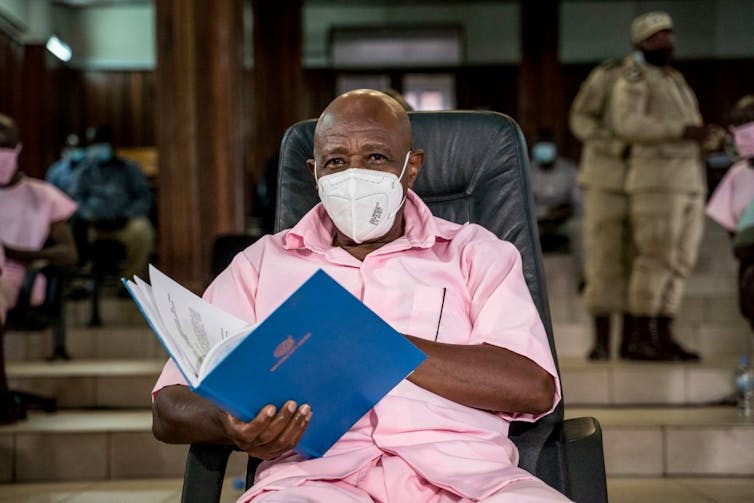
    Paul Rusesabagina at the Supreme Court in Kigali, Rwanda, in February 2021. Simon Wohlfahrt/AFP via Getty Images

    Jonathan Beloff, King’s College London

    Paul Rusesabagina is perhaps one of the world’s best known Rwandans. His actions during the 1994 genocide against the Tutsi were made famous in the 2004 Hollywood film Hotel Rwanda.

    The film was inspired by what happened inside Hotel des Mille Collines in the capital, Kigali. Here, 1,268 Rwandans, both Tutsis and Hutus, were saved from genocidal forces waiting beyond its walls.

    The film depicts Rusesabagina – who left Rwanda in 1996 – as a hero who saved these lives. Following the film’s release, Rusesabagina received several humanitarian awards, including the US Presidential Medal of Freedom in 2005 from former president George W Bush. He eventually became a US resident and Belgian citizen.

    On 27 August 2020, however, Rwandan officials arrested Rusesabagina. Human Rights Watch accused the Rwandan government of intentionally misleading him into a flight to Kigali.

    The government accused Rusesabagina of supporting anti-Rwanda groups. He was charged with terrorism, arson, kidnapping and murder over two attacks in 2018 that killed nine Rwandans. On 20 September 2021, Rusesabagina was convicted of these charges. He was sentenced to 25 years in prison.

    Since his conviction, Rwanda has rebuffed growing international pressure for Rusesabagina’s release.

    In August 2022, during a visit to Kigali, US secretary of state Antony Blinken urged the government to release Rusesabagina. In Hollywood, actors and actresses have highlighted the issue through a “Free Rusesabagina” clothing campaign.

    In my most recent research paper, I focused on the Rusesabagina case. Based on interviews with Rwandans, I conclude that Hollywood’s interpretation of historical events significantly differs from those who lived in the hotel during the genocide.

    Hotel Rwanda is a double-edged sword for the country.

    On one hand, it introduced the horrific 1994 genocide to a world that knew little of what had happened in the small African nation. Over 100 days between 6 April and 19 July, Rwanda witnessed the deaths of up to one million Tutsis and moderate Hutus.

    On the other hand, the film’s historical inaccuracies built up Rusesabagina’s profile. Based on what I found during the course of the interviews I did, I argue that he used his fame to promote his version of Rwandan history and his desire for political power. My research findings echo those of others, including Rwandan academics, who have explored the mismatch in narratives.

    Many in the global north, whose primary knowledge of Rwanda consists of the film, were swayed to Rusesabagina’s rather than Rwandans’ expression of their history, goals and desires. This narrative was driven to a large extent by human rights groups, which have been highly critical of the country’s human rights record.

    Differing narratives

    Between 2008 and 2018, more than 100 Hotel des Mille Collines survivors discussed with me their historical experiences and belief that Rusesabagina was not the reason they were still alive. I conducted most of these interviews at the hotel and the Kigali Genocide Memorial, which houses the remains of more than 250,000 genocide victims. My research also used existing networks within the Rwandan government and civil society organisations.

    Survivors who were at the hotel said Rusesabagina ran the hotel as a personal profit-making venture.

    If one could not pay him, one would face expulsion from the hotel’s grounds, which meant certain death. One survivor said:

    If you could pay, you would stay in a room. If you couldn’t pay for a room, you could pay to stay in a hallway. If you couldn’t pay that, you could pay to stay by the pool. If you couldn’t pay that, he (Rusesabagina) would demand you to leave.

    One hotel worker told me this:

    He (Rusesabagina) didn’t care about any of us (workers). I begged him to let them (my family) stay as I was working there (at the hotel) for a long time. He didn’t care and demanded I pay him money or he would throw them out to be killed.

    Several other survivor stories suggest a different narrative from the one in the film. In Hotel Rwanda, Rusesabagina is depicted as collecting money only to pay off genocide perpetrators.

    Rusesabagina during the genocide

    Prior to the genocide, Rusesabagina worked at the neighbouring Hotel des Diplomates. He took over the management of Hotel des Mille Collines after discovering that its European manager, Bik Cornelis, had been evacuated. One former hotel worker told me:

    …a few days into the killings, Rusesabagina walked in one day and saw that the old manager (Cornelis) was taken with the other Europeans. He called (the hotel owners) and told them to … only work with him. They had no idea what was going on and probably hadn’t talked to Cornelis yet, so they agreed.

    While the film credits Rusesabagina with creating an oasis during the conflict, he’s not the reason the hotel – one of the few areas offering refuge at the time – survived attacks from those behind the genocide.

    Not depicted in the film are the seven to 10 United Nations Assistance Mission in Rwanda (UNAMIR) soldiers who were constantly positioned in front of the facility.

    In his book, Roméo Dallaire, a former commander of this UN mission, says he stationed troops at the hotel’s only entrance as a symbolic indication that it was under the UN’s protection. Dallaire has spoken out against Hotel Rwanda as historical revisionism.

    Further, the Interahamwe, the primary Hutu death squads responsible for the genocidal killings, had been directed to stay outside the walls of the hotel. They allowed people to run into it, but would threaten or kill those who tried to leave.

    One former Interahamwe who had been stationed about 20 metres from the hotel’s entrance told me that he received instructions from his regional commander to “just stay put by the hotel and to allow the Tutsis and others to have access”. The hotel was also used for prisoner exchanges “and it would be the final spot for us to cleanse (murder the Tutsis) once we beat the RPF (Rwandan Patriotic Front)”.

    The Rwandan Patriotic Front, led by Paul Kagame, took control of the country in July, ending the genocide. The horrors of the 100-day period led to Rwanda’s focus on forming a new single ethnic identity: “Rwandan”.

    Jonathan Beloff, Postdoctoral Research Associate, King’s College London

    This article is republished from The Conversation under a Creative Commons license. Read the original article.