Categories
Book Review

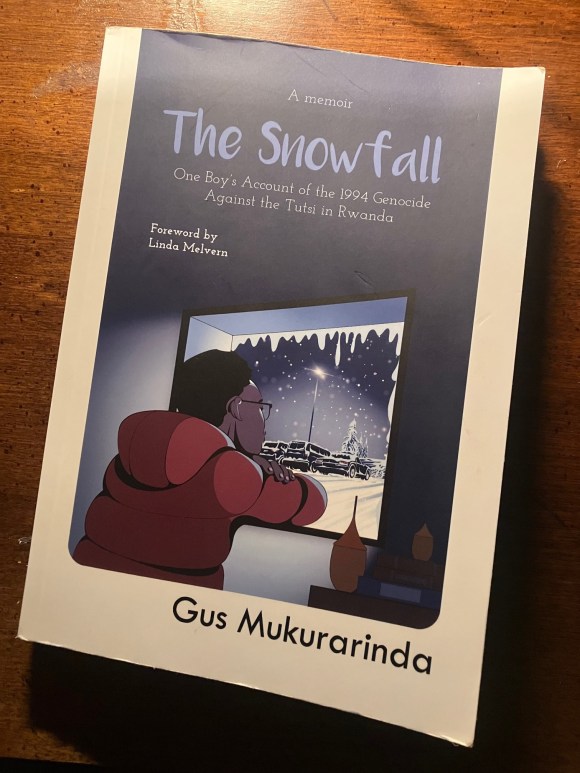
The Snowfall: One Boy’s Account of the 1994 Genocide against the Tutsi in Rwanda

Mukurarinda, Gus. The Snowfall: One Boy’s Account of the 1994 Genocide against the Tutsi in Rwanda, (London: Palmetto Publishing, 2025). ISBN: 979-8-8229-8276-5 Link

Over the years, I have interviewed or spoken with hundreds of people in Rwanda, trying to incorporate their comments, stories and arguments into my understanding not just of the nation but of the broader African Great Lakes region. However, I typically try to avoid testimony books, as they offer a glimpse into someone’s life, whether during a specific period or over a long span. While they can provide a picture of a broader event or struggle, they often only focus on what was around the author at the time. They typically cannot provide insights into the larger picture of a historical event. There are only a few people whose lived experience can aid in our understanding of something grand. Additionally, I cannot ask questions or challenge what I am being told, as the literature is often in its final form, unlike an interview. However, they can still be a piece in a much larger puzzle, requiring the reading of not only other testimonies but also other literature sources that cover the broader topic.

For survivors’ testimony of their experiences during the 1994 Genocide against the Tutsi, this issue becomes even grander. Despite the expectation of many, I do not categorise myself as a genocide researcher. Rather, I am a researcher of Rwanda and the broader African Great Lakes region. It requires an in-depth knowledge of Rwanda’s horrific genocide, including events leading to its beginning during Belgian colonisation, to holistically understand the region. This notion has at times separated me from former academic peers who often minimise the impact of the Genocide against the Tutsi when describing current political, economic and security issues within the region.

During my most recent visit to Rwanda, I had the pleasure of meeting Gustave (Gus) at the Kigali Genocide Memorial. He seemed eager to meet me after a mutual friend told him I was at the Memorial’s café. Along with Gus, a few mutual friends sat down with me to discuss Rwanda and my current research. One asked if I had read Gus’ recent book about his survival during the genocide. I politely responded that I had not, with one person running to give me a copy of the book.

When I was given the book, I was initially hesitant to accept it. I explained that, despite having read more books than I can count on the African Great Lakes region, I typically avoid reading testimonies. The people were a bit shocked, as they were aware of my vast experience conducting interviews with former RPA, ex-FAR, genocide survivors, perpetrators and bystanders. However, I explained the methodological process I often use, with existing written testimonies often being further down the list of sources. As mentioned, I cannot challenge or ask questions of a book that has only the scope the author provides.

Nevertheless, I agreed to read the book.

The story follows the author’s (Gus) lived experience as a small child in the southern Rwandan city of Nyanza. Its timeframe initially begins in Canada as a young adult, but quickly changes to when he was a young boy in the weeks before and days during the Genocide. Thus, much of the book takes place between the beginning of April and the liberation of Nyanza at the end of May, 1994. This relatively short period, only two months, contains more experiences than most of us would ever live in our lifetime. This becomes even more pressing when we remember that Gus is only a boy.

My intention is not to spoil the story, but it addresses concepts of memory, family, trust, and the importance of luck amid horror. For many survivors of the Genocide against the Tutsi, it was luck which aided in their survival. Gus is no exception. In particular, there is one evening when he, along with two others, including his younger sister, navigates the hellscape of the Interahamwe roadblocks to reach what they had hoped would be safety. It was luck which guided them to the safe hands of other people, those who refused to participate in the massacres, which eventually led them to the Italian orphanage and religious site, Centre St. Antoine.

Gus provides unique insight into the horrors of Nyanza through his lived experience. There are mentions of broader politics and historical events. An example is how in the Southern Province, local leaders tried to prevent the Genocide from spreading into their villages, towns and cities until the Genocide Prime Minister Jean Kambanda demanded local support and threatened that it would not be provided. However, we can only learn about it through Gus’s childhood memories. The book provides a micro view of the effects of macro-level decisions that impacted not just Gus and those around him but a country which is still grappling and rebuilding since the genocide. 

This is not the only mention of Rwandan history. Early in the testimony (Chapter Three: Storytime), prior to the genocide’s start, Gus recounts a story in which older family members, later referred to as grandparents, along with his Papa, discuss Rwanda’s ethnic history. This includes elements of the 1959 Hutu Revolution, such as the expulsion of Tutsis from their homes and their relocation to the less developed, swampy areas of Bugesera. The story shows how Belgian helicopters, Kajugujugu, were deployed to aid in the removal of the Tutsi. Additionally, this talk was highly memorable as it taught Gus and his siblings how their grandparents were killed on Christmas, 1963. It is here that we see not only the role of oral history within Rwandan society but also generational trauma stemming from Hutu extremist ideology.

While reading the book, a question rose in my mind: why is this book significant compared to other testimonies I have read in the past? After reading roughly a third of the book, I began to remember a conversation with an American teacher. He reached out to me several years ago asking what I would recommend he show to his high school class about Rwanda. He was aware of the (fictional) Hotel Rwanda, but read my article about its historical fabrications.

For many years, I have rallied against Hotel Rwanda as it is a mishandling (to put it lightly) of what happened in Rwanda during the Genocide against the Tutsi. It elevated a man who was at the very least an opportunist if not an accomplice in the genocide. The film elevated a man who, at the very least, now denies the genocide and aided, if not led, a rebel force, the Front de Libération Nationale (FLN), which killed Rwandans in a feeble attempt to gain power. However, most in the West have little interest in depicting an accurate story about Africa, let alone Rwanda. So, once again, why did this film come to mind while reading this book? However, it then became clear.

This book is the answer to that high school teacher’s question. The Snowfall provides a way to introduce non-Rwandan students to the horrors of the Genocide against the Tutsi. It does not overwhelm the reader with either too much information or graphic depictions of the Genocide’s true horrors. Rather, it reminded me of the famous Diary of a Young Girl by Anne Frank. Many schools require students to read the diary as their way to fulfil state requirements on teaching the Holocaust. One of Amsterdam’s busiest attractions is the famous Anne Frank Museum, where Anne Frank, her family, and others tried to hide.

Gus’ story should be read as Rwanda’s answer to The Diary of a Young Girl. Unlike the problematic Hotel Rwanda, this book provides a first-hand account of the Genocide’s horrors without trying to promote a political message for personal gain. While he does praise the Rwanda Patriotic Army (RPA) for rescuing him, there are no overt political messages. Rather, Gus’ book provides historically accurate, emotional insight into the horrors kids experienced in 1994.

This book is also important for younger Rwandans to read. Most born after 1994 only know the Genocide as a historical event which destroyed their country. They do not have the lived experience of that horror. The Rwandan government pushes for genocide education such as commemorations, memorials and, when available, education programs. However, more is needed for younger post-1994 Rwandans to understand the horrors through those who suffered. This book can provide that insight so the younger generations understand the pain and importance of post-genocide reconciliation and rebuilding.

Thus, I recommend The Snowfall not only to Rwandans but also to non-Rwandans seeking to understand what a typical day was like for Tutsis during the Genocide against the Tutsi. Most importantly, I believe this book should become required reading for non-Rwandan students to gain a glimpse of the genocide’s horror.

And this recommendation comes from someone who often does not recommend books on testimony.

Categories
Book Review

Book Review: Slow Poison: Idi Amin, Yoweri Museveni and the Making of the Ugandan State

Mamdani, Mahmood. Slow Poison: Idi Amin, Yoweri Museveni and the Making of the Ugandan State. Harvard University Press, 2026. Link

Several months ago, a Ugandan friend of mine reached out with a joke about New York City’s upcoming 2025 mayoral election. It was the election between former New York Governor Andrew Cuomo and Democratic Socialist Zohan Mamdani, the son of the famed academic writer Mahmood Mamdani. The Ugandan joked that New Yorkers should be proud that their next mayor (Zohan Mamdani) found a way to connect two seemingly contradictory actors: Uganda’s forced-exiled South Asian community, of which the Mamdani family was part, and Idi Amin. When I asked what possible connection there could be between the two, he responded, “Well, they both hate Israel.”

This seeming contradiction crossed my mind while reading Mahmood Mamdani’s new book, Slow Poison. It is hardly the first time I read Mamdani’s works, as I have read several past books. For Rwandan-focused researchers, Mamdani is best known for his book, When Victims Become Killers, where he tries to conceptualise the Liberation/Campaign against Genocide War (he simply calls it the Civil War) and the Genocide against the Tutsi. While this is not a summary review of that book, he does insist that a guiding reason for the initial war was Ugandan internal politics rather than the anti-refugee ideology and Hutu extremism of former Rwandan President Juvénal Habyarimana.

However, I initially heard about Mamdani’s new book through rumours that it would focus more on recent Ugandan history (compared to Subjects and Citizens, for example). I had largely forgotten about it until I saw Ugandan opposition leader Bobi Wine (Robert Kyagulanyi Ssentamu) posted a tweet about reading the new book. Ugandan President Yoweri Museveni’s son and commander of the Ugandan military, General Muhoozi Kainerugaba, responded to the tweet (which I believe has been deleted) in his typical way. Putting that issue aside, the tweets reminded me of Mamdani’s book, which I ordered immediately. Surprisingly, at the same time, one of my closest friends residing in Kenya attended one of Mamdani’s book tour talks, where the author said the book was more of an autobiography than any of his past ones.

After reading the book, I asked myself one simple question: What is the central argument/story/point Mamdani is trying to address? At times, while reading the book, I thought its central focus was the author’s life. However, he would drift away to discuss other subjects without properly connecting them back to this topic. Perhaps there is another central focus, such as Idi Amin? Or was it about Museveni’s tenure as President? Perhaps it was to ignore African agency in order to blame the British and Israelis for all of Amin’s horrific acts? Perhaps the reason the book reads as unorganised stems from the fact that Mamdani writes in the acknowledgements that he wrote this book over the course of a decade (2010-2022). It is hard to write a book with an organised structure, underlying themes, and clarity over such a long period of time. I will get back to this issue later on in this review.

The book has multiple historical issues, for example, when discussing his relationship with former Congolese President Joseph Kabila and General James Kabarebe. Mamdani recalls that in Tanzania, he would debate dependency theory, Marxism, and liberation struggles with Joseph Kabila, among other topics. However, he probably meant Joseph’s father, Laurent-Désiré Kabila, the first President of the Democratic Republic of Congo (DRC) after the First Congo War (1996-1997). Joseph would have only been a small child at most during those interactions. This would not be the only time the father-son relationship is historically misplaced. Interestingly, when he briefly mentions the Second Congo War (1998-2003), he puts the conflict’s blame on Rwanda and, to a lesser extent, Uganda. He ignores how Congolese President Laurent Kabila began aiding former Hutu extremist forces, including former genocidaires of Rwanda’s Genocide against the Tutsi, which was the point of no return for the Rwandan government. However, this lack of inclusion should not be seen as unique.

For instance, despite accusing Israel of Idi Amin’s rise to power, Mamdani ignores how Amin allowed, and even supported, the hijacking and attack on Jewish and Israeli passengers on Air France Flight 139 and Israel’s subsequent successful Operation Entebbe. Oddly, this subject is barely, if at all, mentioned as Mamdani tries to paint Amin as a puppet of the British and, particularly, the Israelis. At any given moment, he excuses Amin’s horrors, flatly denying them in Chapters 7 and 8, and instead just scapegoats the Israelis and British. This raises questions about neocolonial perceptions of African agency, but that is a debate for another time. He overblows and strips away African agency by exaggerating Israel’s influence in Ugandan domestic and military politics. This should not come as a surprise, as Mamdani is a vocal critic of Israel, who tries to justify Hamas’ genocidal attack on October 7, 2023. I suppose even the great Mamdani was unable to justify the Air France hijacking, so he ignored it.

Additionally, he claims that General James Kabarebe met him at Kigali International Airport in 1986, which, as most Rwandans and Rwanda-focused scholars would know, is impossible. While at the surface, many of these small issues might just come from a poor editor who either did not catch them or would not want to contradict the established Mahmood Mamdani. However, I am aware that some Rwandans will raise an eyebrow about this historical inaccuracy.

The lack of clarity and historical inconsistencies leads back to the question: What is the point of this book?

The only consistent theme I found in the book is Mamdani’s animosity towards President Museveni. This is despite Mamdani acknowledging that President Museveni offered him opportunities to help the Ugandan state after 1986, but not on the author’s terms. The book’s final section, ‘The National Resistance Movement: Tribalizing the Nation,’ is a relative hodgepodge of different domestic and foreign policy blunders by President Museveni and, to a lesser extent, the National Resistance Movement (NRM), which governs Uganda. The critiques are hindered by multiple issues, such as the lack of a proper critical review of the positive and negative outcomes of those policies, the policies’ prior establishment, and the context in which the decisions were made. Fundamentally, does Mamdani wants to paint President Museveni as the ultimate ‘bad guy’ of Ugandan history? However, unlike other scholars who provide a clear argument with justifications and room for further debates, Mamdani’s conclusions feel absolute. Is this a mixture of William Easterly’s Tyranny of Experts and Thomas Sowell’s Intellectuals and Society?

But conceptualising the book as a means to criticise those he does not approve of makes more sense when reading the book a second time. As mentioned earlier, Mamdani seemingly excuses Amin’s horrific acts. He has a list of methods to try to accomplish this through calling human rights abuses of Amin as either ‘British propaganda’, ignoring evidence of corruption and torture, or just blaming the Israelis and, to a lesser extent, the British. At the surface, this might seem inconceivable. How could someone excuse the horrors of Amin when they were impacted by it through the horrific 1972 Asian expulsion?

However, this contradiction aligns with current trends among some academics. I have noticed (within Rwandan studies) a trend to rewrite Rwandan history to make the regimes of Grégoire Kayibanda (1962-1973) and Juvénal Habyarimana (1973-1994) less horrific than they really were. While they will likely claim it is an attempt to reconceptualise and reexamine Rwandan history, it often reads more like an attack on Rwanda’s present-day political leadership, led by President Paul Kagame and the Rwanda Patriotic Front (RPF). One of the core tenets of the current Rwandan government is its portrayal of itself as instituting policies that correct or address the errors of past regimes. Some scholars attack this concept to deny the RPF’s moral foundation. This includes, for instance, how the RPF combats past Hutu extremism and identity politics through Ndi Umunyarwanda. However, anyone who talks to Rwandans in Rwanda who lived during those past republics would testify that these claims are rubbish and that life is better now than before.

The reason I briefly stopped to discuss Rwanda is to illustrate how I see a similar method at work in Mamdani’s new book. As expected, rather than discussing the RPF, his target is President Museveni. However, the means to the end are similar. While reading the book a second time, I felt the manuscript’s focus was more on attacking Museveni by elevating Amin’s horrific regime. By trying to scapegoat or deny Idi Amin’s horrors, it takes away from the credibility of President Museveni. The President’s son, General Muhoozi Kainerugaba, often defends his father by describing how much worse off Uganda was under Amin. By elevating one, even the man who forced his family into exile, he can condemn the other. This dichotomy is not only wrong but also contradicts what academics should be teaching students within the social sciences. While Uganda has its issues, like every other country, some of them even severe, his suggestion is extremely problematic and will entrench President Museveni’s supporters even more.

Overall, I am disappointed in Mamdani’s new book despite the initial high hopes. I am still not sure about the book’s central argument. Was it a biography with some political/historical events sprinkled through? Is the book an attempt to rehabilitate one of Africa’s cruellest leaders, Idi Amin? Or is this book an attempt to discredit President Museveni? If I read the book a third time, will I think the central argument is something else? Any of these answers would require the book to have a clear argument/focus/goal. Or perhaps, my expectations are simply too high, but even in books I disagree with, I can still find something to learn from and enjoy.

However, I cannot say that about this book, but I am probably the only one who will…

Categories
Book Review

Review: The Struggle for Liberation: A History of the Rwandan Civil War, 1990-1994

Kegel, John Burton. The Struggle for Liberation: A History of the Rwandan Civil War, 1990-1994, (Ohio University Press, 2025) ISBN: 978-0-8214-2627-2 (Link).

In 2019, I sat at Kigali Heights sipping a Mutzig (a local beer) with Lt General (Rtd) Caesar Kayizari. While we initially met when he was still Chief of the Army, within the Rwanda Defence Forces (RDF), it was during his retirement that he sparked an interesting question: how did Rwanda’s Genocide, known as the 1994 Genocide against the Tutsi, actually end? General Kayizari was one of the commanders of a combined mobile force (CMF), specifically Alpha CMF, which liberated large swaths of Kigali. Since his retirement, General Kayizari showed me different areas of Kigali and explained the military battles and rescue operations that took place there in 1994. By 2022, it sparked an idea that eventually led to my own research project on the subject. However, General Kayizari mentioned that someone else had already begun the research: John Burton Kegel.

Kegel’s relationship with General Kayizari served as a metaphorical ‘green flag’ for the authenticity of his research. Academia faces significant challenges, stemming from internal divisions, in understanding and critically engaging with Rwanda. As I wrote in a past article, the divide over whether to praise or condemn Rwanda, specifically its government under President Paul Kagame and the Rwanda Patriotic Front (RPF), is evident in nearly every piece of published material. In the past, some academics privately advised me that, to succeed in academia, one must find oneself on the ‘right’ side of this academic divide. This divide impacts researchers’ fieldwork, especially early-career researchers’, with many Rwandans commenting that they often feel Western researchers arrive in Rwanda with their conclusions already determined. However, Kegel does not fall into this trap as he seeks to understand and describe how the Rwandan Patriotic Army (RPA), the military wing of the RPF, won the Rwandan Civil War[1].


Kegel’s book, The Struggle for Liberation: A History of the Rwandan Civil War, 1990-1994, examines a relatively unexplored but vital period of Rwandan history. Akin to Gerard Prunier’s The Rwanda Crisis, Kegel’s book is a holistic examination of Rwanda and how conditions led to the formation of the RPF, which remains in power. However, Kegel presents an interesting historical parallel to Rwanda’s early post-colonial years with the 1990s Civil War. He argues that Rwanda experienced two significant periods of civil war. The second is the better-known Rwandan Civil War (1990-1994), but the first period is more interesting.

The original civil war began during the Social (Hutu) Revolution and lasted until the mid-1960s, ultimately leading to the defeat of the Union Nationale Rwandaise (UNAR) rebel forces from Burundi. Often, descriptions of the late colonial period focus on political divisions and the consolidation of Hutu ideology. Kegel’s description of the period is most convincing in sparking a new debate within Rwanda studies: should the period around Independence be considered part of a civil war, given that it encompassed many of the elements necessary to qualify as one? Within Rwanda, the Genocide against the Tutsi often receives its initial date during the Social (Hutu) Revolution rather than simply 1994. The reason stems from a modified understanding of Gregory H. Stanton’s description of a genocide’s lifeline.

An added note: there appears to be a rise in Rwandan historical books that attempt to rehabilitate the regimes of Gregoire Kayibanda (1962-1973) and Juvénal Habyarimana (1973-1994). Perhaps it is a tactic in a strategic campaign to try to discredit the RPF by disrupting their (and historical) narratives of the social and economic problems during those periods. However, it could be a genuine exploration of Rwandan history. Kegel never falls for this trap, as he provides a factually accurate account of Rwanda’s history prior to 1994.

Fundamentally, Kegel examines how history has shaped the RPF and Rwanda. However, we begin to encounter a blessing and a problem with the book’s research. The Struggle for Liberation utilises French, Dutch, British, American, and Belgian diplomatic records and cables, drawing on them in ways that go beyond any existing texts on Rwanda. The book describes and illustrates not only historical events but also how those serving at foreign embassies in Rwanda described the nation’s events. The only other person, I believe, who has done this type of research is Linda Melvern.

However, we encounter my first issue with the book: a lack of interview data. Kegel’s sources rely on diplomatic cables, existing information, and the interviews of a handful of people, all RPF. Those mentioned as the primary source of the interview data are Lt General (Rtd) Ceasar Kayizari, General James Kabarebe, Senator (Rtd) Tito Rutaremara and Christine Umutoni. While I hold the utmost respect (and friendship) with these people, there needed to be more voices, including those from the former Rwandan Armed Forces (FAR). When the existing interview data is properly utilised, it elevates the description and overall storytelling of Rwandan history. However, the book needed more of their voices.

This is where Kegel and my book differ. While he provides a more holistic examination of the RPF and Rwandan history, mine focuses more on the Campaign against Genocide War. It extensively utilises interview data from those who fought during the war, including RPA and ex-FAR members, to depict the various tactics, operations (humanitarian and military), and strategies of both sides. My book positions itself as a detailed exploration of Kegel’s Chapter 11, titled “The Campaign Against Genocide”. However, I do fully acknowledge the difficulties it would be for Kegel (or nearly any researcher) to gain the access I received while researching the topic. Nevertheless, I write this critique not to criticise the book, but rather to suggest how it could be elevated through greater use of interview data.

Another critique is what I previously hinted at, the Campaign against Genocide War chapter. This chapter describes the events starting with the assassination of Habyarimana until the RPF liberated Gisenyi, effectively ending the Genocide against the Tutsi. Unfortunately, the chapter reads as rushed compared to other chapters. Additionally, it lacks details of the RPA’s strategy compared to the ex-FAR, operational decision-making, humanitarian missions, the relationship between battles and tactics, and so on. All of these topics are mentioned and discussed, but only briefly. The reason I mention this issue is that many Rwandans are most interested in learning about this aspect of their history. Many want to understand not just the history of the RPF/RPA, but also how those forces liberated their home, village, town or city. 

There are other minor critiques I have of the book, such as its portrayal of the ex-FAR. The limitations of the research methods are evident here as well. Kegel discusses some of the internal controversies among its officers, in part due to the diplomatic cables. However, it largely does not address the complex relationship within the FAR. For instance, the divide between Northern and Southern Hutus (something current Minister of Defence Juvenal Marizamunda experienced); perceptions of the Arusha Accords or even how to categorise the RPF (Commissioner General of Rwanda Correctional Service Brigadier General Evariste Murenzi, who fought for the FAR, remembers being told in October 1990 that he was not fighting ‘Tutsis’, Mwami supporters or foreign invaders. Rather, his commander said they were fighting fellow Rwandans who were refugees.) These divisions are important as they greatly influenced decision-making during the Genocide by those within the military, and why some refused to participate in the massacres.

Rather than condemning these missing elements, it may be worth suggesting that our two books be read together. Where Kegel shines is where my own research could be strengthened and vice versa. That realisation is what makes this book even more enjoyable. Its level of historical detail will hopefully lead to new debates and research on how the RPA ended the Genocide against the Tutsi. One of its greatest contributions is how it should lead to new critical questions about Rwanda for us to understand better not only its history but how it exists today as it continues to rebuild and recover from the great horror of the Genocide.

Despite my minor critiques, I believe this book will be one of the great texts on Rwanda in the years to come. Akin to the previously mentioned Prunier’s The Rwanda Crisis, Kegel’s book will serve as a textbook for understanding Rwandan history. I highly recommend it, and then suggest either visiting my site or reading my book on the Campaign against Genocide War.


[1] Civil War is a general term to describe the Liberation War (1990-1993) and the Campaign against Genocide War (1994).