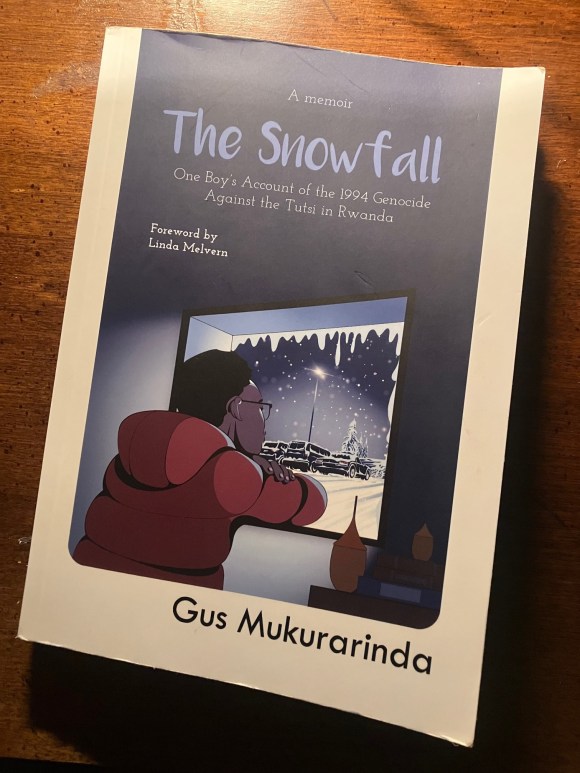
Mukurarinda, Gus. The Snowfall: One Boy’s Account of the 1994 Genocide against the Tutsi in Rwanda, (London: Palmetto Publishing, 2025). ISBN: 979-8-8229-8276-5 Link
Over the years, I have interviewed or spoken with hundreds of people in Rwanda, trying to incorporate their comments, stories and arguments into my understanding not just of the nation but of the broader African Great Lakes region. However, I typically try to avoid testimony books, as they offer a glimpse into someone’s life, whether during a specific period or over a long span. While they can provide a picture of a broader event or struggle, they often only focus on what was around the author at the time. They typically cannot provide insights into the larger picture of a historical event. There are only a few people whose lived experience can aid in our understanding of something grand. Additionally, I cannot ask questions or challenge what I am being told, as the literature is often in its final form, unlike an interview. However, they can still be a piece in a much larger puzzle, requiring the reading of not only other testimonies but also other literature sources that cover the broader topic.
For survivors’ testimony of their experiences during the 1994 Genocide against the Tutsi, this issue becomes even grander. Despite the expectation of many, I do not categorise myself as a genocide researcher. Rather, I am a researcher of Rwanda and the broader African Great Lakes region. It requires an in-depth knowledge of Rwanda’s horrific genocide, including events leading to its beginning during Belgian colonisation, to holistically understand the region. This notion has at times separated me from former academic peers who often minimise the impact of the Genocide against the Tutsi when describing current political, economic and security issues within the region.
During my most recent visit to Rwanda, I had the pleasure of meeting Gustave (Gus) at the Kigali Genocide Memorial. He seemed eager to meet me after a mutual friend told him I was at the Memorial’s café. Along with Gus, a few mutual friends sat down with me to discuss Rwanda and my current research. One asked if I had read Gus’ recent book about his survival during the genocide. I politely responded that I had not, with one person running to give me a copy of the book.
When I was given the book, I was initially hesitant to accept it. I explained that, despite having read more books than I can count on the African Great Lakes region, I typically avoid reading testimonies. The people were a bit shocked, as they were aware of my vast experience conducting interviews with former RPA, ex-FAR, genocide survivors, perpetrators and bystanders. However, I explained the methodological process I often use, with existing written testimonies often being further down the list of sources. As mentioned, I cannot challenge or ask questions of a book that has only the scope the author provides.
Nevertheless, I agreed to read the book.
The story follows the author’s (Gus) lived experience as a small child in the southern Rwandan city of Nyanza. Its timeframe initially begins in Canada as a young adult, but quickly changes to when he was a young boy in the weeks before and days during the Genocide. Thus, much of the book takes place between the beginning of April and the liberation of Nyanza at the end of May, 1994. This relatively short period, only two months, contains more experiences than most of us would ever live in our lifetime. This becomes even more pressing when we remember that Gus is only a boy.
My intention is not to spoil the story, but it addresses concepts of memory, family, trust, and the importance of luck amid horror. For many survivors of the Genocide against the Tutsi, it was luck which aided in their survival. Gus is no exception. In particular, there is one evening when he, along with two others, including his younger sister, navigates the hellscape of the Interahamwe roadblocks to reach what they had hoped would be safety. It was luck which guided them to the safe hands of other people, those who refused to participate in the massacres, which eventually led them to the Italian orphanage and religious site, Centre St. Antoine.
Gus provides unique insight into the horrors of Nyanza through his lived experience. There are mentions of broader politics and historical events. An example is how in the Southern Province, local leaders tried to prevent the Genocide from spreading into their villages, towns and cities until the Genocide Prime Minister Jean Kambanda demanded local support and threatened that it would not be provided. However, we can only learn about it through Gus’s childhood memories. The book provides a micro view of the effects of macro-level decisions that impacted not just Gus and those around him but a country which is still grappling and rebuilding since the genocide.
This is not the only mention of Rwandan history. Early in the testimony (Chapter Three: Storytime), prior to the genocide’s start, Gus recounts a story in which older family members, later referred to as grandparents, along with his Papa, discuss Rwanda’s ethnic history. This includes elements of the 1959 Hutu Revolution, such as the expulsion of Tutsis from their homes and their relocation to the less developed, swampy areas of Bugesera. The story shows how Belgian helicopters, Kajugujugu, were deployed to aid in the removal of the Tutsi. Additionally, this talk was highly memorable as it taught Gus and his siblings how their grandparents were killed on Christmas, 1963. It is here that we see not only the role of oral history within Rwandan society but also generational trauma stemming from Hutu extremist ideology.
While reading the book, a question rose in my mind: why is this book significant compared to other testimonies I have read in the past? After reading roughly a third of the book, I began to remember a conversation with an American teacher. He reached out to me several years ago asking what I would recommend he show to his high school class about Rwanda. He was aware of the (fictional) Hotel Rwanda, but read my article about its historical fabrications.
For many years, I have rallied against Hotel Rwanda as it is a mishandling (to put it lightly) of what happened in Rwanda during the Genocide against the Tutsi. It elevated a man who was at the very least an opportunist if not an accomplice in the genocide. The film elevated a man who, at the very least, now denies the genocide and aided, if not led, a rebel force, the Front de Libération Nationale (FLN), which killed Rwandans in a feeble attempt to gain power. However, most in the West have little interest in depicting an accurate story about Africa, let alone Rwanda. So, once again, why did this film come to mind while reading this book? However, it then became clear.
This book is the answer to that high school teacher’s question. The Snowfall provides a way to introduce non-Rwandan students to the horrors of the Genocide against the Tutsi. It does not overwhelm the reader with either too much information or graphic depictions of the Genocide’s true horrors. Rather, it reminded me of the famous Diary of a Young Girl by Anne Frank. Many schools require students to read the diary as their way to fulfil state requirements on teaching the Holocaust. One of Amsterdam’s busiest attractions is the famous Anne Frank Museum, where Anne Frank, her family, and others tried to hide.
Gus’ story should be read as Rwanda’s answer to The Diary of a Young Girl. Unlike the problematic Hotel Rwanda, this book provides a first-hand account of the Genocide’s horrors without trying to promote a political message for personal gain. While he does praise the Rwanda Patriotic Army (RPA) for rescuing him, there are no overt political messages. Rather, Gus’ book provides historically accurate, emotional insight into the horrors kids experienced in 1994.
This book is also important for younger Rwandans to read. Most born after 1994 only know the Genocide as a historical event which destroyed their country. They do not have the lived experience of that horror. The Rwandan government pushes for genocide education such as commemorations, memorials and, when available, education programs. However, more is needed for younger post-1994 Rwandans to understand the horrors through those who suffered. This book can provide that insight so the younger generations understand the pain and importance of post-genocide reconciliation and rebuilding.
Thus, I recommend The Snowfall not only to Rwandans but also to non-Rwandans seeking to understand what a typical day was like for Tutsis during the Genocide against the Tutsi. Most importantly, I believe this book should become required reading for non-Rwandan students to gain a glimpse of the genocide’s horror.
And this recommendation comes from someone who often does not recommend books on testimony.

